California exceeds clean car goal despite declining federal support
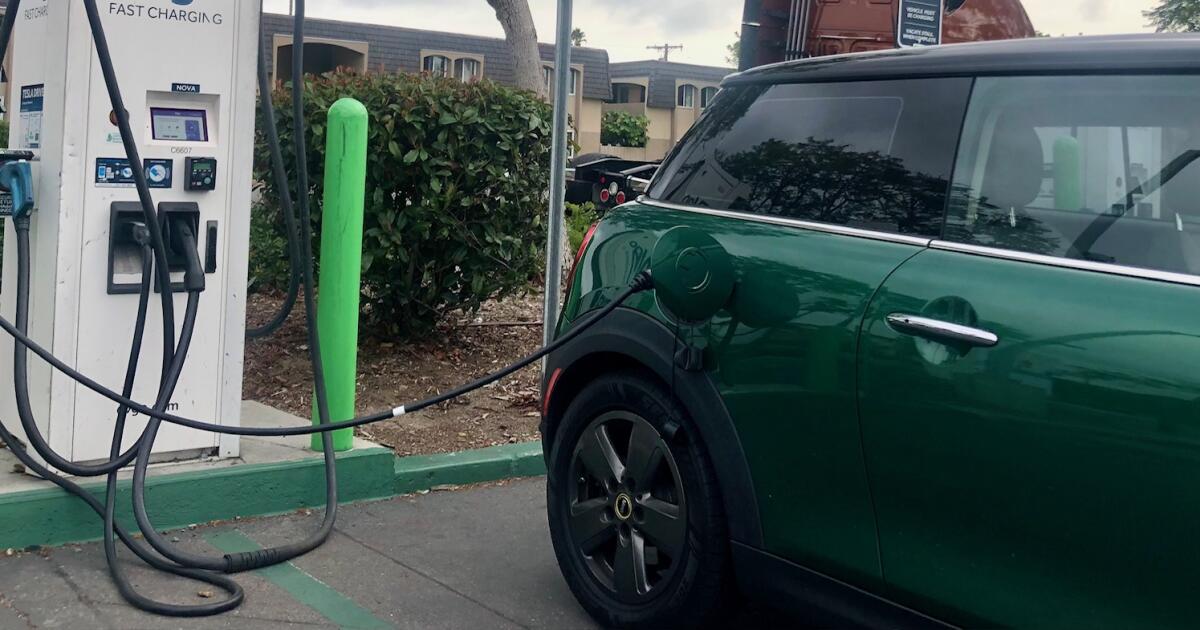
More than 2.5 million electric vehicles have been sold in California since 2010, exceeding one of the state’s EV goals despite setbacks in clean energy brought on by the Trump administration.
This week at the World Economic Forum in Davos, Switzerland, Gov. Gavin Newsom announced that the Golden State surpassed a target to put 1.5 million zero-emission vehicles on the road by 2025.
Former Gov. Jerry Brown set the goal in 2012 with an executive order that also allocated $120 million for charging infrastructure. Prior to 2010, fewer than 600 zero-emission vehicles had been sold in the state, according to the California Energy Commission.
“California didn’t reach 2.5 million zero-emission vehicles by accident — we invested in this future when others said it was impossible,” Newsom said in a statement. “California is ensuring American workers and manufacturers can compete and win in the industries that will define this century.”
Shortly after taking office for the second time, President Trump signed an executive order that cut funding for charging infrastructure, eliminated a $7,500 EV tax incentive and abandoned an earlier goal that EVs make up half of new cars sold nationally by 2030.
Inflation and auto tariffs have also acted as boundaries to EV adoption as cash-strapped drivers aim to avoid the higher price of purchasing and insuring an EV.
Nearly 23% of new vehicles sold in California in 2025 were considered zero-emission vehicles, though EV sales were down in the state and across the U.S. compared to the year prior.
California counts plug-in hybrid vehicles as zero-emission even though PHEVs rely on a combination of gas and electricity.
EV sales jumped last year ahead of the expiration of the tax credit as consumers rushed to take advantage of the incentive. After the credit was eliminated on Sept. 30, sales declined sharply.
Nationwide, the share of electric vehicles sold among all new vehicles fell from 10.5% in the third quarter last year to 5.8% in the fourth quarter, according to Cox Automotive.
Despite the achievement touted in Davos, California failed to reach a separate goal approved by the California Air Resources Board in 2022 that 35% of new cars must be zero-emission by 2026. The Advanced Clean Cars II Rule requires 68% of new cars be zero-emission by 2030, and 100% by 2035.
In the fourth quarter of 2025, only 18% of new cars sold in the state were zero-emission.
California’s EV market has still proven resilient in the face of declining federal support.
The state leads the country in EV adoption and has a network of more than 200,000 public and shared charging stations, the governor’s office said.
In response to the loss of the federal EV tax credit, Newsom proposed a $200-million incentive program to accelerate EV adoption in his Jan. 9 budget. Private companies are creating their own incentives too, such as Costco, which offers members $1,000 off several electric Cadillac models.
In addition to consumer incentives, the California Energy Commission’s Clean Transportation Investment Plan includes a $98.5-million allocation for light-duty zero-emission vehicle infrastructure.
“While the federal government reversed and put up roadblocks, the global zero-emission vehicle market surged ahead last year,” said California Air Resources Board Chair Lauren Sanchez in a statement. “Governor Newsom’s new rebate proposal sends a clear message: California isn’t slowing down, we’re still leading the pack.”