NYC stray cats found carrying parasites linked to serious human illness
More than half of New York City’s free-roaming cats are infected with parasites that can spread to people, according to a new study, with young male cats shedding the highest numbers of parasite eggs into the environment.
Widespread Infection Found
Researchers tested 87 free-roaming cats captured through a Trap Neuter Return (TNR) program in New York City between May and July 2023. Fecal flotation testing found that 57.5 percent of the cats carried at least one parasite species.
The most common was Toxocara, a roundworm that infected 54 percent of the cats sampled. Ancylostoma, or hookworm, was found in 13.8 percent, and coccidia, a single-celled parasite, was detected in 11.5 percent of the animals.
Additional testing turned up further infections. Giardia, another microscopic parasite, was also found in 11.6 percent of cats tested. Blood testing showed that 8.9 percent of cats had antibodies to Toxoplasma gondii, a parasite that can cause serious illness in pregnant women and people with weakened immune systems.
No cats tested positive for heartworm antigen or for Cytauxzoon felis, a tick-borne parasite.
Dr. Ayesha Bryant, the clinical advisor of Alpas Wellness in Maryland, spoke with Newsweek about the findings.
“This study is a good example of how animal, human, and environmental health are closely related to each other, a theory known as One Health,” she said. “The fact that over 50 percent of sampled free roaming cats had zoonotic parasites doesn’t necessarily mean that 50 percent of humans will become infected with these parasites; however, it reinforces the need to reduce contact with contaminated soil and animal waste.
“The results of this study provide evidence for effective methods for prevention rather than cause for concern. Individuals should be encouraged to practice hand washing after participating in other outdoor activities. It’s also important to wear gloves when digging in soil, cover sand boxes when not in use, immediately remove cat litter/feces from the yard, and encourage owners of domesticated cats to seek regular veterinary check-ups and administer parasite prevention.”
Newsweek has contacted the study’s authors for additional comment.
Young Male Cats Are ‘Super-Shedders’
The study found that male cats were more than four times as likely as female cats to be infected with Toxocara. Male cats and cats under one year old also shed significantly higher numbers of Toxocara eggs in their feces than other cats.
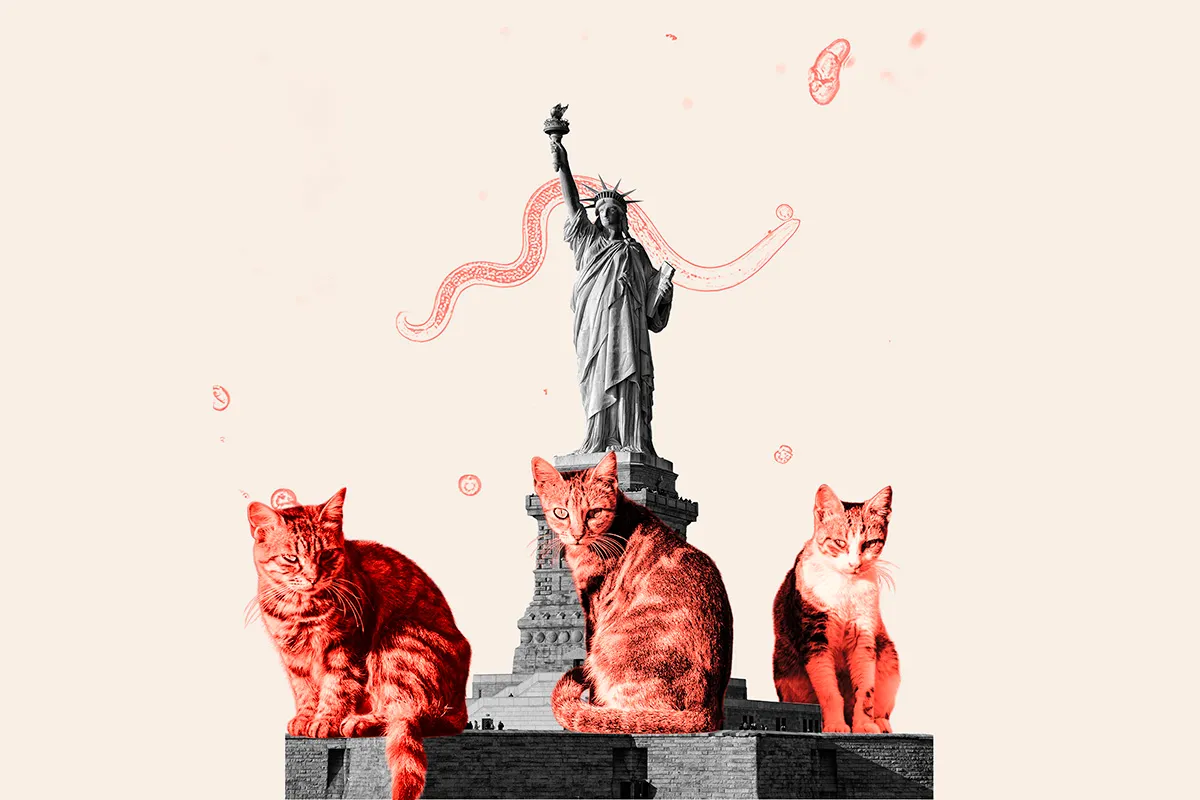
Researchers described these young male cats as “super-shedders,” meaning a small subset of the population is responsible for contaminating a disproportionate share of the shared urban environment with parasite eggs.
Toxocara eggs shed in cat feces can survive in soil for long periods and are a known cause of toxocariasis in humans, particularly children, who can be infected after contact with contaminated soil or sandboxes. The infection can, in rare cases, cause vision loss or organ damage.
Why It Matters for Public Health
The study’s authors said the findings point to a public health risk tied to New York City’s large population of unmanaged, free-roaming cats, which live in close contact with people, pets and wildlife in dense urban areas.
They said the results support building disease surveillance directly into TNR programs, so that veterinarians already trapping and sterilizing cats can also monitor for parasites that pose risks to human health. TNR programs are widely used in cities to control feral cat populations without euthanasia, by trapping, neutering and returning cats to where they were found.
The NYC Health Department told Newsweek: “We routinely monitor several zoonotic diseases that can spread between animals and people and work closely with animal and human health care professionals and partner agencies. The findings from this paper emphasize the need to properly care for unowned cats. While only some of the parasites evaluated pose a risk to humans, they may pose a greater health threat to other cats, owned and unowned, dogs, and the many species of wildlife.”
The spokesperson added: “Current public health recommendations remain unchanged as the risk to New Yorkers remains low. New Yorkers should wash their hands, avoid contact with animal waste, and ensure pets receive routine veterinary care. People who are pregnant or have weakened immune systems should take extra precautions when handling cat litter or animal waste. Parents and caregivers should also make sure that children wash their hands thoroughly after playing outdoors.”
The study was funded by institutional startup funds from Long Island University’s College of Veterinary Medicine and Rowan University’s Shreiber School of Veterinary Medicine.
Reference
Nguyen, V., Gurtowski, E., Chen, J. (2026). Zoonotic endoparasites and Toxoplasma gondii seropositivity in free-roaming cats (Felis catus) from New York City boroughs. PLOS One. Zoonotic endoparasites and Toxoplasma gondii seropositivity in free-roaming cats (Felis catus) from New York City boroughs | PLOS One.
Contact Newsweek editors on this story: Kara Dolman and Emma Lee-Sang