Christopher Nolan on Helen, Athena, and His New ‘Odyssey’ Ending
In our initial interview, Nolan was reluctant to discuss the ending of The Odyssey. He’s known as the master of the last-act twist, and likes leaving the audience with more questions than answers. He told me he never wants to impose his interpretation on others. (Are Cobbs’ kids in Inception real or imagined? You decide.) But when I hopped on the phone again shortly before the film’s release to have a spoiler-filled chat about the film’s final act—readers beware!—he offered some insight as to why he made certain changes when adapting the epic poem.
We discussed the surprising parallels between The Odyssey and Oppenheimer, why Nolan decided to give Odysseus and Penelope the happy ending they don’t get in Homer’s epic poem, and how to interpret Zendaya’s mysterious character: Is she actually a goddess or merely a manifestation of Odysseus’ guilt? We also dug into Zeus’ Law and the deeper meaning behind Helen’s scarred face.
TIME: Odysseus is a man who suffers from PTSD, and, in your interpretation, who believes he’s responsible for the end of a civilization because he violated the ethical code by which the ancient Greeks lived their lives.
Nolan: My form of storytelling is, you take a hero, as we did with Oppenheimer, and Oppenheimer has all these flaws, all of these complexities. You find an actor who can take the audience on a journey with that character and make mistakes with that character and not judge that character. And then you step back from that character and go, “Well, how did we get here?”
[For this movie,] you do that through Odysseus’ men. That’s one of the things in the poem that’s breezed over—the way in which the crew ends up getting killed one by one, despite his leadership. In the process of adaptation, you go, “That’s actually pretty interesting. Maybe we need to make that more center stage.” What’s the relationship between him and his crew? How do they feel about how he’s leading them and the things that befall them?
He’s a guy who makes a lot of mistakes. His ultimate mistake is the horse. So there’s a sort of tragic flaw right from the beginning in our telling.
Nolan with Matt Damon as Odysseus and Zendaya as Athena on set of The Odyssey. Melinda Sue Gordon—Universal Pictures
My interpretation of Zendaya’s character is that she is not Athena as Odysseus initially present her—gods don’t exist in this world—but a manifestation of his guilt. During the sack of Troy, we see her as a priestess in the Temple of Athena, and the Greeks behead her. For Odysseus, she encapsulates the chaos that the horse has wrought on the world. But my editor did not interpret it that way. I am hoping you will settle our disagreement.
I couldn’t possibly answer that because I learned very early on with Memento that it’s unfair to define the experience for the audience by answering questions like that.
Here’s what I will say: For me, what was important was that we view the gods the way that people at the time might have viewed them. So they’re seeing evidence of the gods in nature. They’re seeking and finding gods and the influence of gods in the people around them. Odysseus says to Telemachus, “Don’t look for gods in men. You’ll just be disappointed.” And some of what Odysseus says about divinity, to me, is somebody who’s protesting a bit too much, someone trying to live in denial of their own instincts and their own practices.
I was struck by the parallels between Oppenheimer and Odysseus, two brilliant men who create a tool of devastating destruction and then struggle with the guilt of what they have done. When I spoke to Matt Damon, I asked, “What did you think when you first read the script?” And he said, “It felt like Oppenheimer.” I assume that was a conscious choice.
Yes. If I’ve done a film right, it leaves me with questions. It leaves me with things I want to keep exploring and thinking about. And Oppenheimer fed very much into my reading of the story of Odysseus.
John Leguizamo [who plays Odysseus’ friend Eumaeus] says it at the very beginning: “That’s very clever, but your cleverness will get you in trouble.” As it does again and again and again. This is where it ties into Oppenheimer: Just because you can doesn’t mean you should. The parallels were pretty apparent to me as I figured out how to adapt it.
The movie hinges on this idea that by creating the Trojan Horse, Odysseus destroys “Zeus’ law.” That’s the movie’s term for the ancient Greek concept of xenia—the respectful relationship between host and guest—which can be tricky to explain to a modern audience. Why was it important to include?
When you find these things are difficult to deal with, sometimes the solution is just to dive in and make it everything. I didn’t use the term xenia because you don’t want to throw too many terms at people. But it’s essentially the golden rule. It all comes back to weather, to geography. When you leave the house, you are depending on the kindness of strangers, and you have to trust that when you arrive somewhere after weeks or months of traveling, that you will be fed, you will be given water. Three thousand years ago, that was everything. You were always at the mercy of strangers. And so this idea that a stranger could be a god in disguise, it’s very powerful as the underpinning of a belief system.
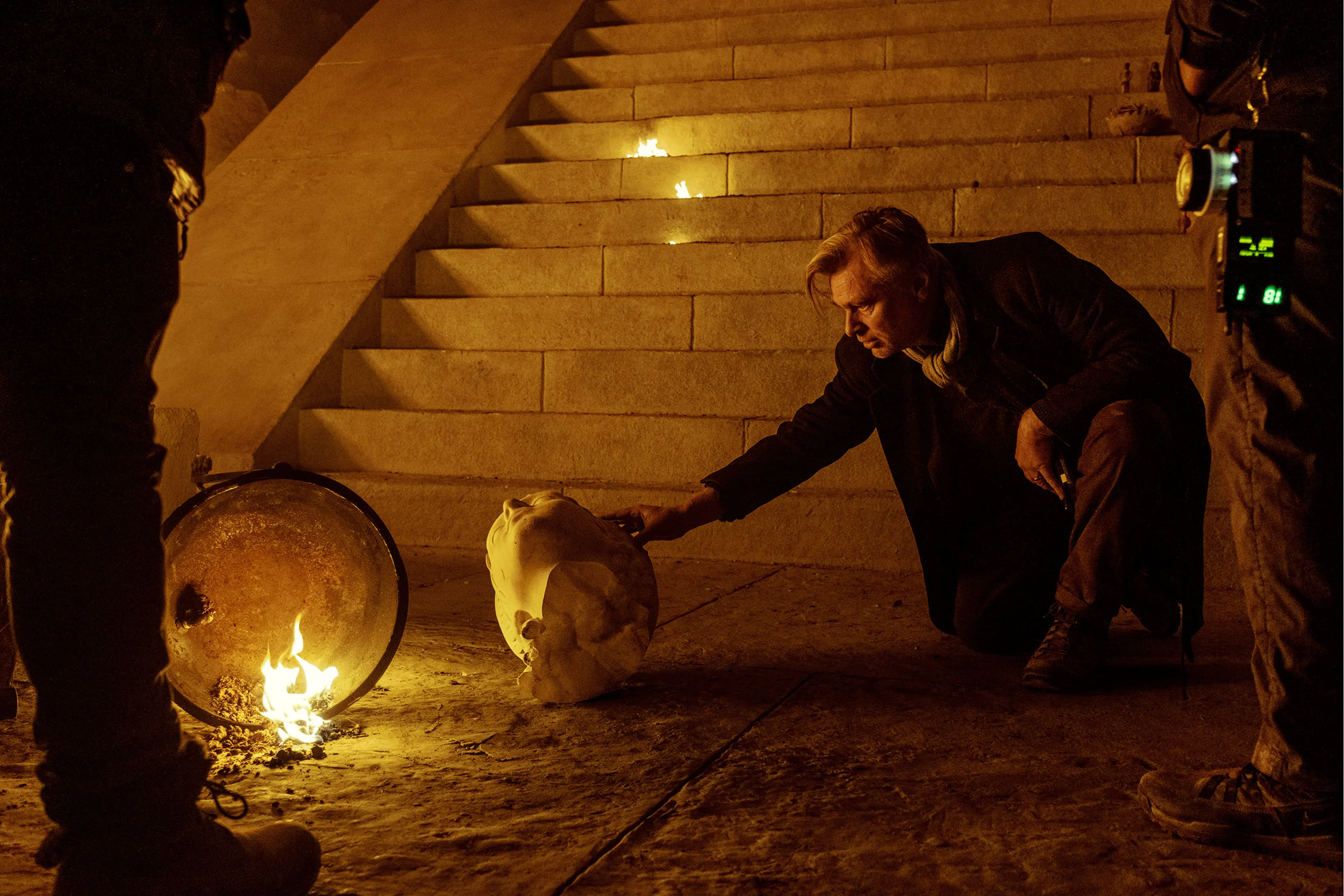
Christopher Nolan filming the Sack of Troy in The Odyssey Melinda Sue Gordon—Universal Pictures
At different points in the film, if man is given the opportunity, he becomes a beast. A soldier will behead a priestess. You imply that Menelaus purposefully scarred Helen’s face either because he believes she’s responsible for the Trojan War or to prevent anyone from taking her again.
That line, “The face that launched 1,000 ships, or maybe just 500” just occurred to me to write. Sometimes what you do as a writer is purely instinctive. I felt the poem didn’t necessarily address what it is for Helen to be brought back by Menelaus and how that would ever work. How would that relationship be? How could it possibly be anything other than the most acidic, awful marriage?
You don’t buy that he saw her face and said, “She’s so beautiful I can’t kill her after all,” as he does in the myth?
There’s a lot of sh-t that’s happened in that relationship, and we have a very brief moment of time with them in this story. I was looking for a shorthand way to communicate the aftermath of the war and how it’s been traumatic for the entire world.
You also see this idea of man as beast in the scene with Circe. She says that Odysseus’ men would have raped and killed her—that they’re pigs. Then you get to the end and see the sack of Troy and the horror of what they did. She’s right.
Circe articulates it well in the film. I love the way Samantha [Morton] has played the part. Talking about choices of adaptation, the end of the poem is so grim and so misogynistic, I had to exclude some of that material. But I didn’t want to completely take it off the table in terms of what it is saying about men and the way they wage war.
And yet you give Odysseus and Penelope a happy ending that they do not get in the poem.
Well, it is the fall of civilization, so there is a fairly bleak sensibility. The end is talking about cycles, and you can view cycles pessimistically: History is doomed to repeat itself. But there is also something optimistic about those cycles. As Penelope says, “Civilization will rise again.” There is rebirth and regrowth.
For me, it was important in looking at the ending to try and strike the right balance between pessimism and optimism—pessimism about what might have precipitated the Bronze Age catastrophe and the optimism that positive things will reassert themselves.