

SLUG: After SQ321, Two Singapore Teenagers are Using AI to Tackle a Climate-Driven Aviation Threat
As climate change fuels the rise of clear-air turbulence, Singapore students Ishaan Puri and Anvay Mathur are building an AI-powered flight-planning app to help pilots predict the invisible hazard before take-off.
In May 2024, Singapore Airlines flight SQ321, flying from London to Singapore, plunged into severe Clear Air Turbulence (CAT), leaving one dead, and dozens injured. Unlike turbulence associated with thunderstorms, clear-air turbulence occurs in seemingly cloudless skies, making it virtually invisible to pilots and traditional weather radars. For most, it was another unfortunate aviation accident. For Ishaan Puri and Anvay Mathur, two Singaporean high school students, however, it became a deeper, more technological question:
If Clear Air Turbulence could be so devastating, why could it not be predicted earlier?
The question sent them, both rising seniors at the Singapore American School, down a rabbit hole of atmospheric science, aviation and artificial intelligence. Having begun coding in sixth grade before teaching himself Python, Puri had always gravitated towards solving real-world problems through technology. Aviation, however, was an entirely new territory.
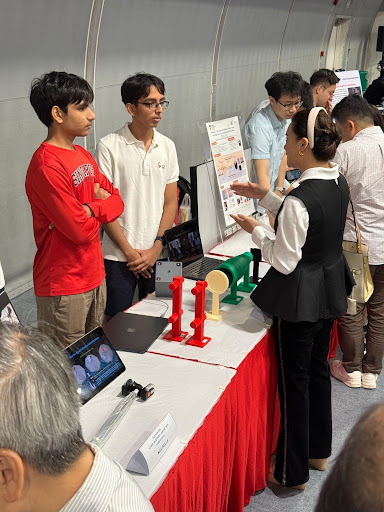
The tragedy of SQ321 sparked a conversation between Puri and Anvay Mathur, his classmate and childhood friend – and both went ahead and founded SensAir, a tool to detect CAT. Initially, they developed a laser-based hardware system capable of detecting turbulence ahead of the aircraft in real-time. The prototype won them first Prize at the Conrad Challenge in the Aerospace and Aviation Category, making them the first team from Singapore to win the prestigious innovators award.
For many student innovators, the award might have marked the finish line. For them, it became the moment they started over.
Despite the recognition, Puri and Mathur realised the hardware presented a fundamental problem. Installing highly sensitive sensors across commercial aircraft fleets would be costly, technically complex and difficult to scale. Rather than spending months refining an award-winning prototype, they abandoned it altogether and rebuilt the project around artificial intelligence, convinced software offered a more practical and scalable solution.
Reflecting on the decision to abandon the award-winning prototype and moving towards a software model that relies on forecasts as opposed to real-time predictions, Puri says, “The goal stayed the same. It’s just the way we got it.”
Today, Puri leads the development of SensAir’s AI prediction model, while Mathur is developing the web-based flight-planning platform and user interface app that pilots will ultimately interact with. Designed as a pre-flight planning tool, the app aims to allow pilots to visualise predicted CAT before departure, helping them identify safer flight paths before encountering turbulent airspace. The team hopes to launch the first version of the platform in August and has already begun testing it with pilots flying smaller aircraft, using their feedback to refine both the AI model and the user experience ahead of a wider rollout.
Rather than relying on sensitive hardware mounted on aircraft, Puri’s AI model is trained using historical weather data, satellite imagery and pilot reports. By analyzing patterns in atmospheric conditions that have previously produced CAT, the system learns to identify where turbulence is most likely to occur. Instead of replacing pilots, Puri believes artificial intelligence should equip them with better information before they make critical decisions.
The timing is significant. Research by Mark Prosser et al, including atmospheric scientist Paul Williams from the University of Reading found that severe clear-air turbulence over the North Atlantic increased by 55 per cent between 1979 and 2020. Scientists attribute the increase in climate change to altering the jet stream a fast moving river of air high in the atmosphere (above 15,000 ft) that commercial aircraft often fly near and increasing wind shear, or sudden changes in wind speed and direction that create pockets of unstable air where CAT can develop.
Beyond the human toll, turbulence is estimated to cost roughly $150 – 500 million annually in the U.S. alone through delays, aircraft inspections, maintenance and injuries, underscoring the growing need for more accurate forecasting.
Building the technology required far more than writing code. With no aviation background, Puri and Mathur began cold-emailing industry professionals around the world, determined to learn from those already working in the field. Those conversations soon evolved into discussions with pilots, aerospace engineers and aviation executives, leading to mentorship, partnerships with Laminaar Aviation, and feedback from experts at Airbus and Boeing that helped shape the product around real operational needs rather than theoretical assumptions.
For them, however, technology has never been the end goal. They argue that artificial intelligence should not replace pilots, but make them more capable. As climate change makes the skies increasingly unpredictable, they hope SensAir will give pilots the information they need to make safer decisions before turbulence strikes.
As SensAir prepares for its launch in August l, Puri and Mathur know the technology will continue to evolve long after its first release.
“We’ll have to test it,” Puri says. “If it doesn’t work, we’ll reiterate.”
For someone who willingly abandoned an award-winning idea to build a better one, that philosophy seems fitting.
