Rare lunar eclipse to cover 96% of moon this week—how to watch
Skywatchers across much of the United States will have the chance to witness one of the most dramatic lunar eclipses of the decade this week, as Earth’s shadow covers more than 96 percent of the moon‘s surface during a rare deep partial lunar eclipse.
According to NASA, the eclipse will occur overnight on August 27 or 28, when the Earth passes directly between the sun and the full moon, casting its shadow across the lunar surface.
At the moment of greatest eclipse, 96.3 percent of the moon’s visible disk will lie within Earth’s dark central shadow, known as the umbra.
While not technically a total lunar eclipse, the event comes remarkably close. According to NASA, only a thin sliver of the moon will remain in direct sunlight at maximum eclipse.
Why Is This Eclipse So Rare?
Partial lunar eclipses occur relatively frequently, but deep partial eclipses of this magnitude are far less common.
This eclipse is part of Saros 138, a long-running series of lunar eclipses that repeat every 18 years, 11 days and 8 hours as the Earth, moon and sun return to nearly the same alignment.
NASA says the previous eclipse in this series occurred on August 16, 2008, while the next one will not take place until September 7, 2044.
Astronomers are paying particular attention to this event because it’s among the most dramatic lunar eclipses visible in the coming years. Unlike many partial eclipses, where only a modest section of the moon enters Earth’s shadow, this eclipse will produce views more commonly associated with a total lunar eclipse, potentially allowing much of the lunar surface to take on reddish or copper hues.
What Will People See?
As the eclipse progresses, observers will see a dark shadow slowly move across the face of the full moon.
During the early stages, a subtle dimming will be visible as the moon enters Earth’s outer shadow, or penumbra. Later, once the partial phase begins, Earth’s darker umbral shadow will appear to take a growing “bite” out of the moon.
Near maximum eclipse, the remaining sunlit portion of the moon will shrink to a narrow crescent. The shadowed section may glow shades of red, orange, or copper because sunlight passing through Earth’s atmosphere is filtered and bent toward the lunar surface. The same process helps create red sunsets on Earth.
“The coppery color of the part of the Moon within the umbra” can become more noticeable as observers’ eyes adapt to the darkness, according to NASA.
When Will It Be Visible?
The eclipse reaches its maximum at 4:13 a.m. UTC on August 28, which corresponds to:
- 12:13 a.m. EDT (U.S. East Coast) on August 28
- 11:13 p.m. CDT on August 27
- 10:13 p.m. MDT on August 27
- 9:13 p.m. PDT (U.S. West Coast) on August 27
Where in the U.S. Will It Be Visible?
Much of the United States will enjoy favorable viewing conditions.
According to NASA and Time and Date, the eclipse will be visible throughout North America, with viewers on the West Coast seeing the event during evening hours and those on the East Coast witnessing the peak around or just after midnight.
Cities including Los Angeles, Portland, New York and Jacksonville will all be well positioned to observe the eclipse.
The event will also be visible across most of South America and parts of western Europe and western Africa.
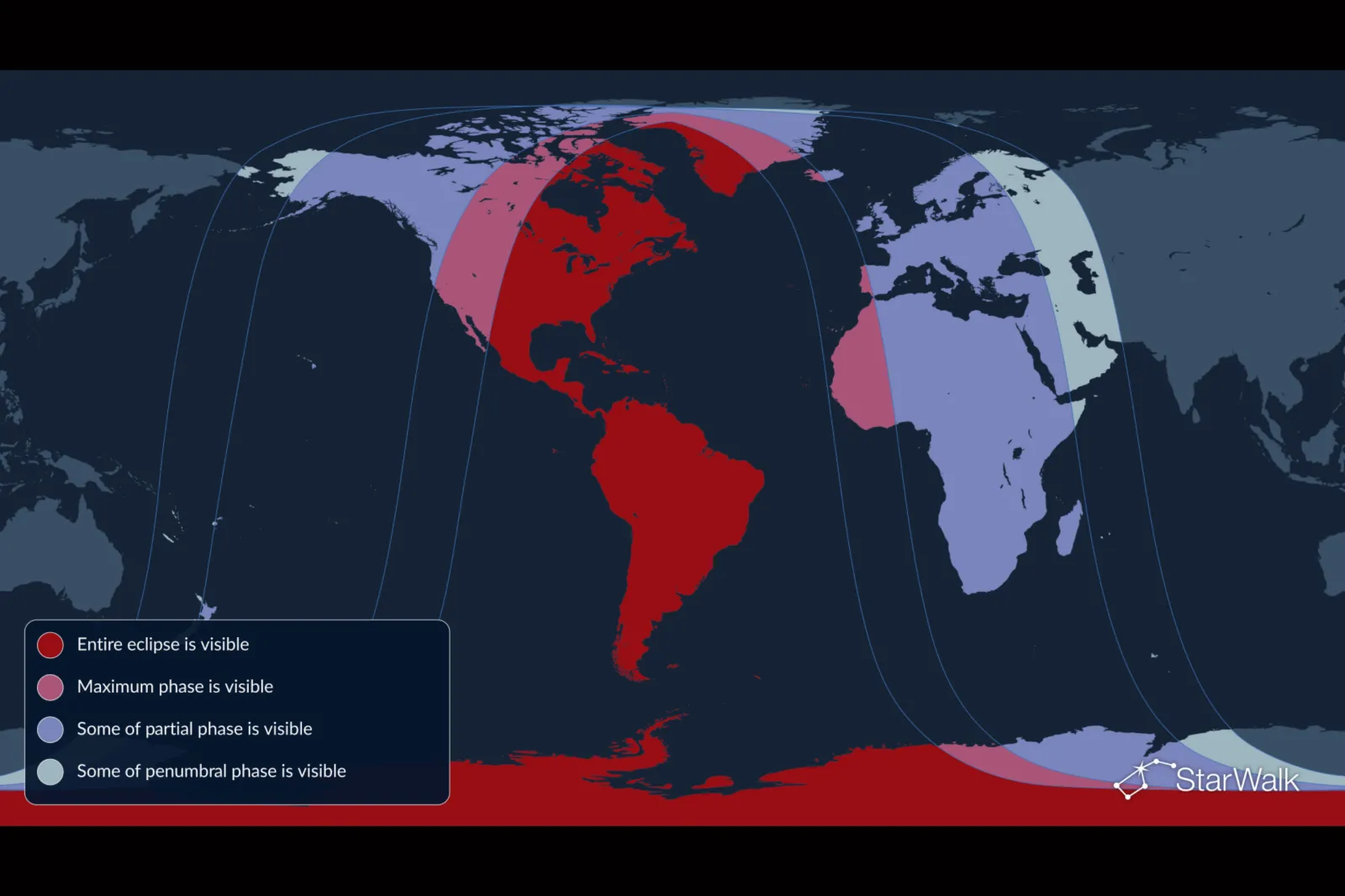
How To Watch The Eclipse
Unlike a solar eclipse, a lunar eclipse can be viewed safely with the naked eye.
According to EarthSky, no special glasses, filters, or protective equipment are required.
Astronomers recommend finding a location with a clear view of the sky and minimal light pollution. While the eclipse will be easily visible without equipment, binoculars or a small telescope can reveal additional detail as Earth’s shadow advances across the moon’s craters and maria.
Clear weather will be the biggest factor determining viewing quality.
For those unable to watch in person, Time and Date plans to carry a live webcast of the eclipse from multiple observing locations around the world.
Contact Newsweek editors on this story: Daniel Orton and Robert Greenall