Singapore overtaken by Ningbo-Zhoushan as second busiest container port in H1
But the H2 figure is still to come, and the lead is too small to say for sure that Singapore is down one rank
[SINGAPORE] Singapore fell by one position to become the third busiest port in the world in the first half of this year, despite handling 4.7 per cent or 22.7 million more 20-foot-equivalent-units (TEUs), as Ningbo-Zhoushan pulled ahead to narrowly overtake it.
The Chinese port was ahead of Singapore for the first time over the six-month period with 22.9 million TEUs, up 8.8 per cent year on year.
Shanghai was at No 1 position with 28.7 million TEUs, a 6.2 per cent rise.
Ningbo-Zhoushan was able to grow faster because of a major expansion in its capacity, which enabled it to handle increased volumes, said Tan Hua Joo, analyst at container shipping intelligence provider Linerlytica.
“Competition among South-east Asia ports also diluted Singapore’s growth, with notable gains in Haiphong, Cai Mep and Tanjung Pelepas,” he added.
Haiphong and Cai Mep are ports in Vietnam, and Tanjung Pelepas is a neighbouring port in Johor, Malaysia.
Container cargo demand was strong across the board in the first half of 2026, Tan noted.
Chen Yang, maritime and shipping service platform Xinde Maritime Network’s managing director, noted in a recent online post that Ningbo-Zhoushan’s lead was only 158,310 TEUs.
The figure is a reflection of the combined effects of China’s expanding and diversifying exports, stronger cargo generation in the Yangtze River Delta, and continued investment in Ningbo-Zhoushan’s capacity and international shipping network.
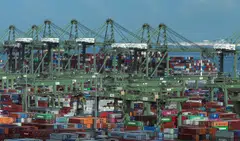
Chen said: “A gap of 158,310 TEU is equivalent to only one or two days of container handling in a port of Ningbo-Zhoushan’s scale. (The lead) is far too narrow to establish a decisive long-term advantage, particularly when part of the global port ranking is still based on estimates that may be adjusted once final figures are available.”
The full-year ranking will depend heavily on cargo flows in the second half, so it is too early to conclude that Singapore has definitively lost its annual ranking, he said.
In 2025, container throughput was a record 44.7 million TEUs for the city-state; that year, Ningbo-Zhoushan logged its highest throughput of more than 43 million TEUs.
China’s peak export season, inventory replenishment in Europe and North America, changes in US trade policy, adjustments to liner shipping networks and the pace at which regular Suez Canal transits recover could all influence both ports’ performance, Chen said.
Meanwhile, Dubai’s Jebel Ali plunged from its 10th position in 2025 to 32nd place globally. Container throughput more than halved to 3.1 million TEUs from 7.8 million TEUs, as it was affected by the Middle East war, said liner data provider Alphaliner.