

Earth’s Protective Shield May Have Disappeared Millions of Years Ago, NASA Study Finds
Earth may have spent parts of its ancient history outside the Sun’s protective bubble. NASA-funded research suggests that the Sun encountered dense, extremely cold clouds of gas and dust about 2 to 3 million years ago, 6 to 7 million years ago, and 13 to 14 million years ago, potentially compressing the heliosphere so much that it shrank inside Earth’s orbit.
The finding offers a striking new way to think about Earth’s climate history. Instead of looking only at changes happening on Earth, scientists are investigating whether the Sun’s journey through the Milky Way itself changed the space environment around our planet.
If the heliosphere became smaller during these encounters, Earth could have been exposed to interstellar material and higher levels of cosmic radiation, potentially influencing the planet’s atmosphere and climate.
Earth’s solar shield can change size
The heliosphere is a huge bubble created by the Sun’s constant stream of charged particles, known as the solar wind. Today, it extends far beyond the planets and acts as a barrier against part of the high-energy radiation arriving from interstellar space. The current heliosphere reaches roughly 120 astronomical units in the direction the solar system is moving.
But this bubble is not fixed.
Its size depends partly on the pressure exerted by the surrounding interstellar environment. As the Sun moves around the Milky Way, it passes through regions with different amounts of gas and dust.
The new NASA-supported work focuses on what could happen when the Sun encounters unusually dense cold interstellar clouds.
Computer simulations indicate that these clouds could push strongly against the heliosphere, squeezing it inward. In some modeled encounters, the heliosphere became smaller than Earth’s orbit, meaning our planet would temporarily have been outside the main solar-wind bubble.
The modeled encounters occurred roughly 2 to 3 million, 6 to 7 million, and 13 to 14 million years ago. Importantly, researchers describe these as modeled or possible encounters, rather than direct observations of the heliosphere collapsing at those exact times. The probability of some of these encounters is also considered low, although not negligible.
NASA’s Goddard Space Flight Center Conceptual Image Lab
Clues from deep-sea sediments and the Moon
One reason scientists are taking the idea seriously is that geological evidence appears to overlap with some of the proposed dates.
Elements associated with interstellar dust have been detected in deep-sea sediment cores, Antarctic material and lunar samples corresponding to some of these periods. The Annual Review analysis notes that evidence from radioactive iron-60 is consistent with something unusual happening around 2 to 3 million and 6 to 7 million years ago.
That does not prove that a collapsing heliosphere caused a particular ice age or climate shift. Instead, it gives scientists clues that can be compared with computer models and Earth’s geological record.
The possible climate connection comes from what happens when the protective bubble contracts. Simulations suggest that exposing Earth’s atmosphere to a dense cloud of galactic hydrogen could increase water vapor and alter conditions in the upper atmosphere. Those changes could eventually affect conditions closer to Earth’s surface.
The researchers therefore suggest that the Sun’s movement through the galaxy may have been one of several outside influences on Earth’s ancient climate.
The Sun’s galactic journey may be part of Earth’s climate story
The idea becomes particularly interesting when scientists look at how frequently these encounters might occur.
Cold interstellar clouds are rare, making up less than 1% of the interstellar medium by volume. But modern observations and data from the European Space Agency’s Gaia mission are allowing researchers to reconstruct the Sun’s past path through the galaxy in much greater detail.
The Annual Review study notes that the Sun moves through its surrounding interstellar environment at about 19 kilometers per second. Over millions of years, that motion carries the solar system through very different regions of space.
Merav Opher, principal investigator of NASA’s SHIELD center at Boston University and lead author of the Annual Review study, and her colleagues are working toward a detailed “digital twin” of the heliosphere. The goal is to model how the Sun’s protective bubble responds to different galactic environments.
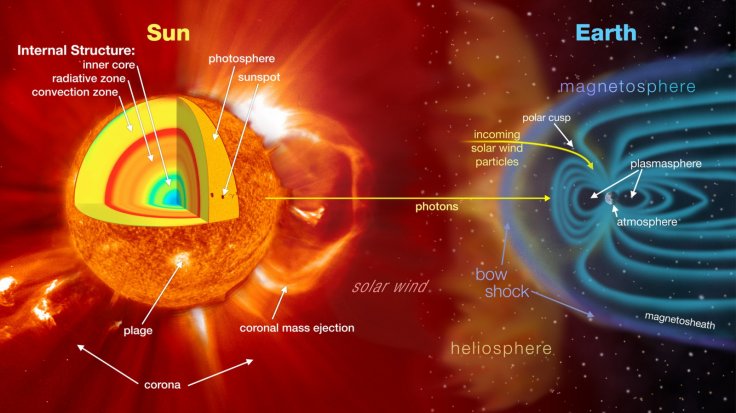
NASA’s Goddard Space Flight Center
There is also a future twist to this story. Researchers estimate that the Sun could encounter the edge of the expanding Local Bubble again in about 7 million years. Because the edges of such structures can contain dense clouds, another compression of the heliosphere is considered possible.
A second ancient solar mystery
The same NASA report highlights another study that looks much further back, to Earth’s early history.
About 3 billion years ago, the young Sun was only around 70% as bright as it is today. Yet geological evidence shows that liquid water existed on Earth. This is known as the Faint Young Sun paradox.
NASA scientist Vladimir Airapetian and colleagues investigated whether the young Sun’s violent activity could have helped solve that puzzle. Young Sun-like stars observed by NASA’s Kepler mission can produce powerful superflares, releasing streams of energetic particles.
In laboratory experiments, researchers bombarded a simulated early-Earth atmosphere with protons. The reactions produced nitrous oxide, a greenhouse gas about 300 times more potent than carbon dioxide. Computer modeling suggested that even if only 10% of the experimentally produced gas survived, it could have raised equatorial temperatures to around 5°C, above the freezing point.
Together, the studies point to a broader idea: Earth’s climate has never been controlled by Earth alone. The planet’s conditions may also have been shaped by where the Sun was traveling through the galaxy and how violently the young Sun behaved.
The heliosphere research is still a developing field, and scientists need more evidence to establish exactly when the Sun encountered these clouds and how strongly those events affected Earth’s climate.
But the possibility is remarkable: some of the climate changes preserved in Earth’s rocks may carry the fingerprints not just of our planet, but of the space environment the entire solar system was passing through.
