Ukraine needs Witkoff’s sickly sweet nothings to Putin
Steve Witkoff certainly knows how to make a Ukrainian reach for the sick bag.
Sitting across from Vladimir Putin in the Kremlin on Saturday, Donald Trump’s special envoy thanked the Russian president for receiving him and Jared Kushner, and promptly puckered his lips to kiss the Russian president’s proverbial behind. “When we retire, we’ll have all these incredible stories and incredible memories, and yours will be right at the top of it all,” Witkoff told Putin.
There are probably better ways to describe negotiations to end a war that has killed and wounded hundreds of thousands, driven millions from their homes, and left Ukraine with an estimated $588 billion in reconstruction and recovery needs than as a cracking yarn for the old folks’ home.
And yet, as Russian troops continue to make slow but steady progress on the front line and jet-powered drones invade Ukrainian skies, Kyiv may need more of Witkoff’s cringeworthy brand of flattery in the months to come.
Every Little Helps
The weekend’s flurry of diplomacy achieved about as much as expected in terms of moving toward a peace deal, which is to say, nothing.
Witkoff and Kushner spent just three hours at the Kremlin on Saturday before wrapping up the talks and heading for Kyiv, but they did manage to produce one thing for war-weary Ukrainians: clear skies.
This was not a nationwide ceasefire; Russians and Ukrainians continued killing one another elsewhere. But Putin ordered Russian forces not to strike Kyiv for three days around the visit, while Ukraine agreed not to hit Moscow—and the agreement held.
Zelensky thanked Witkoff and Kushner on Sunday for “giving the opportunity for our people to live a bit,” joking that their presence had “worked better today than the Patriot systems” on which Ukraine relies to shoot down Russian missiles.
He was only half-joking. Kyiv has spent months absorbing near-nightly barrages as Russia scales its deployment of faster, jet-powered drones that are harder and more expensive to intercept. Ukrainian Air Force spokesman Yurii Ihnat said Moscow launched roughly 350 in June, 1,500 in July and more than 2,800 in August. Ukraine is shooting down only around 60 percent of them, according to Ihnat, compared with 90 to 95 percent of conventional one-way attack drones.
Zelensky also revealed at the weekend that some 67 Ukrainian companies are now working on new air defense systems to bring them down, but made it clear that Kyiv hopes diplomacy, facilitated by Witkoff and Kushner, can deliver results.
“Plan A,” he said, is to “maximally accelerate diplomatic efforts” to reduce Russian escalation. All that air-defense work is Plan B, and every Russian missile and drone that remains grounded because American envoys are in town is one less lethal projectile heading for a Ukrainian city.
If telling Putin how fascinating he will be in retirement buys a few quiet nights in Kyiv, Witkoff should do so over and over again.
Flattery Only Gets You So Far
Witkoff could spend the next six months buttering Putin like a Thanksgiving turkey and still not change Russia’s terms.
Putin aide Yuri Ushakov’s account of Saturday’s talks was uncompromising. The foreign policy veteran described the talks as “useful” and “extremely frank,” but said Putin remained confident Russia would achieve its military objectives and again insisted that any settlement address the war’s “root causes.”
The Russian president defined those terms in June 2024: Ukraine should withdraw from all of Donetsk, Luhansk, Zaporizhzhia and Kherson regions, including territory Russia does not control; accept neutrality and exclusion from NATO; and submit to what Moscow calls “demilitarization” and “denazification.” He also demanded recognition of Russia’s annexations and the removal of Western sanctions.
Ushakov said nothing to suggest Putin has moved from that position. In fact, the aide said Putin had told Witkoff and Kushner of the Russian army’s “tangible advances in the combat zone,” suggesting the Russian president remains convinced his forces can achieve his aims through force.
Flattering Putin will not change his mind; only a material change in the stakes can do that.
Trump’s envoys are also constrained by the format of the negotiations. Shuttle diplomacy—bouncing between Moscow and Kyiv carrying each side’s proposals, objections and interpretations—risks reducing their role from mediators to messengers.
Kushner practically admitted this on Sunday in Kyiv, saying he wanted to restore trilateral talks because previously “we had everyone talking with each other instead of us having to argue the Russian position to the Ukrainians.”
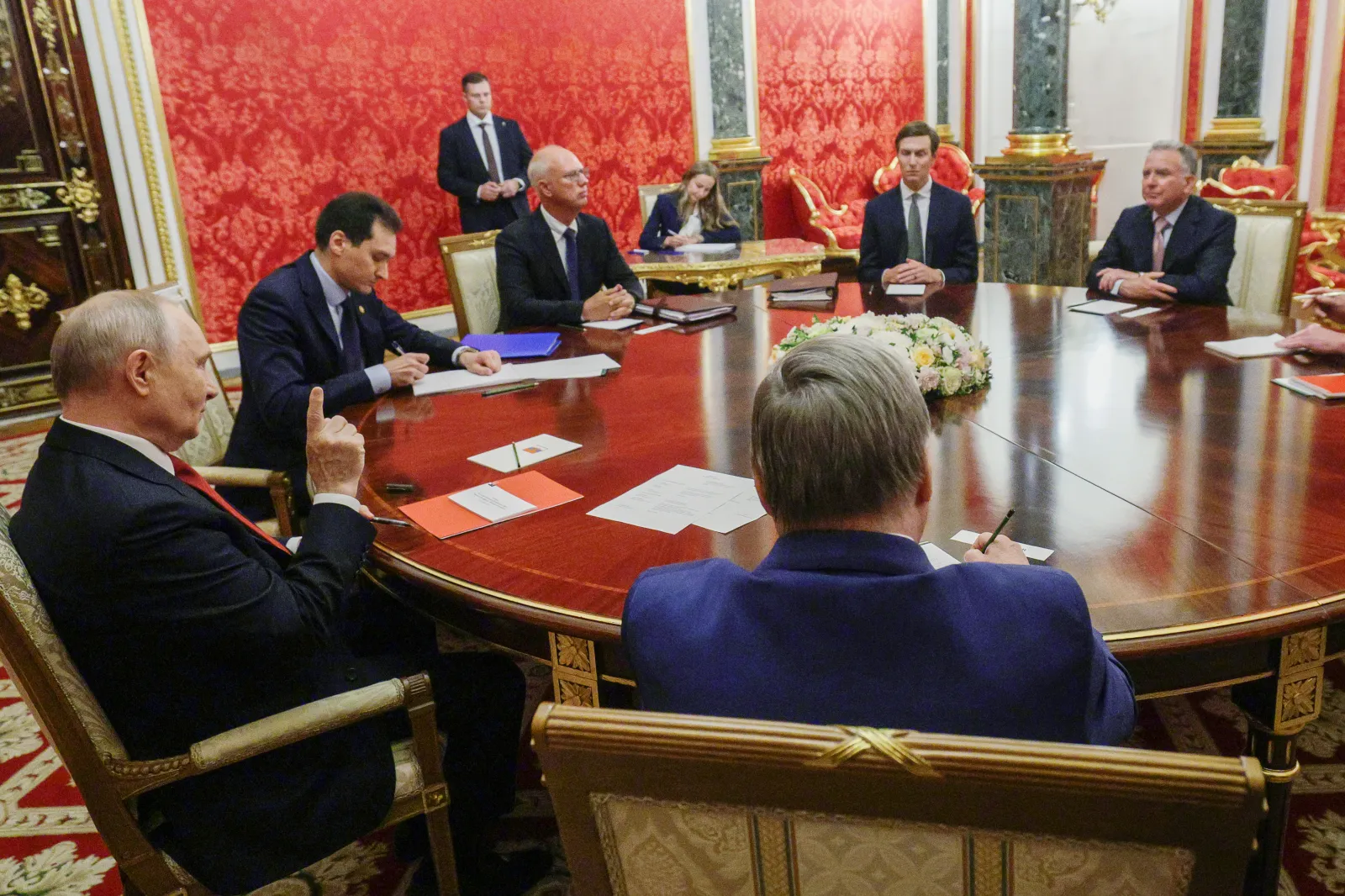
Saturday was Witkoff’s eighth trip to Moscow since Trump returned to office. Sunday’s trip to Kyiv was his first. If Witkoff and Kushner become diplomatic errand boys, future negotiations could quickly devolve into a game of geopolitical broken telephone; one that Moscow has a greater chance of winning by framing its narrative for the American intermediaries and sending them onward to Kyiv with those assumptions in mind.
Baby Steps
Witkoff and Kushner do not look close to ending this war. Zelensky himself said Sunday that, for now, Ukraine expects it to continue through another bleak winter, and unless a notable shift transpires on the battlefield in Kyiv’s favor, Putin has little reason to reexamine his terms
However, if repeated visits to Moscow and Kyiv by Trump’s favorite negotiators can produce regular pauses in the air war, those visits are worth having, no matter how little progress is made toward agreeing a peace settlement.
The more often those pauses happen, the less exceptional they become. A three-day halt agreed for one diplomatic visit creates a precedent for another; repeated precedents can establish expectations about when and how the two sides are capable of restraining themselves. That falls a long way short of peace, but a conflict in which temporary ceasefires become routine offers more to build on than one in which every lull is treated as an anomaly.
If Witkoff’s rosy charm offensive can turn three quiet days into four, then four into something bigger, Ukrainians do not have to enjoy watching it; they just need it to work.