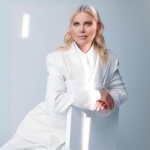
Jewel’s First Major Exhibition Merges Science, Myth and Feminine Power
Jewel is best known for her music, but the Alaskan singer-songwriter grew up surrounded by art. Her mother was a glass artist, and Jewel herself began making art at 15. In conversation with Observer, the artist, who has synaesthesia—a neurological condition that causes her to see fractals and associate color with sound—explains that “they go together. I wouldn’t know how to separate them.” Her debut exhibition “Matriclysm: An Archaeology of Connections Lost” at Salone Verde in Venice brings these worlds together through painting, sound installation, sculpture, textiles and glass.
The show begins with First Mother, which sits outside the entrance. Sculpted in collaboration with Congolese artist Patrick Bongoy, the work references Mitochondrial Eve, the woman from whom the mitochondrial DNA of all living humans can be traced. Made from hessian thread and exposed to the elements, First Mother is intended to disintegrate, inviting contemplation of inevitable natural decay and impermanence. Visitors are encouraged to touch the work, setting the tone for what follows: an exhibition grounded in slow engagement, close listening and embodied experience.
Throughout, Jewel deftly grapples with complicated and often traumatic histories alongside larger scientific and natural phenomena. At its center is a palpable feminine energy, or what Jewel describes as portals into the “undiluted feminine power”: generative, embodied, relational and entirely itself. Rather than treating memory as something fixed, Matriclysm understands it as something living—woven through bodies, motherhood, ancestry, nature and the connections we inherit and inevitably lose. What follows is our talk, lightly edited.
Tell me about the exhibition title and the word “Matriclysm.”
“Matriclysm” is a neologism. I made up the word by combining matriarch and cataclysm. For me, it names the largely unrecorded catastrophe of losing feminine memory and our capacities for connection, while asking what still might be recovered. Feminine memory is the knowledge that’s carried through bodies, rituals, stories and relationships that often history fails to record.

The exhibition started with the question of what happens when a culture loses its connective capacities: to itself, to one another, and to the natural world. I really wanted to create an archaeology of those types of losses, but also a sensory experience that might help us be in touch with what remains. I think attention is the sincerest form of devotion. What we pay attention to is actually what’s sacred to us. The exhibition asks us to notice what has our attention. For me, spirituality isn’t a doctrine. It’s a practice of relationship and attention. It’s a discipline of listening to yourself, to nature, and to the mystery of what connects us beyond language. So I designed the exhibition for slowness. I knew it had to be experienced through the body, not just understood intellectually. That’s when I started really thinking about darkness, sound, touch, slowness, a sense of passage, as though the visitors were moving through an emotional and psychological landscape.
Was there a work that came first?
The Heart of the Ocean came first. She was the anchor piece and I began to build everything else around her. I felt like Venice—this City of Water—was a destined place for her to live in. I call it ‘neuroceutical’ artwork; artwork that’s working with your nervous system. Whilst in Venice scouting for venues, I had this idea: What if I could build an instrument that nature plays? And if I was really loyal to the data and its shape, would it affect your nervous system or brainwave states? Another thought was: We only value what we are in a relationship with. What are we in a relationship with? What are we connecting to? We quit connecting to nature as we became industrialized and urbanized. We quit knowing how much water weighs and how precious it is. We quit knowing where our food comes from. Me growing up in Alaska without running water, with only raising our own food, I have a very deep relationship with the Earth. I wanted to see if I could build something that was like a portal that let you be in relationship with nature directly.
She is technically very complex. How did you go about building her?
I went about building her with the help of NASA and a lot of open-source data: 70,000 data points to be exact, which is 60,000 points of programmable light. I worked with the non-profit ORCA (The Open Research Community Accelerator) and Dr. Erin McKiernan, Professor in the Department of Physics, Biomedical Physics Program at National Autonomous University of Mexico to carry out preliminary studies on her effects on brainwave states. We discovered that she was getting people into Theta brainwave states, which is lucid dreaming, and also Alpha brainwave states, which is a meditative state. At the end of the 12 minutes, people were getting into Gamma brainwave states, which is the highest cognitive function.
Please could you tell me about the thought process behind The Seven Sisters?
The Seven Sisters—a series of handblown glass orbs with an accompanying soundscape—refers to the myth of the Seven Sisters of the Pleiades. It’s thought to be the oldest shared myth in human history, dating back 200,000 years. Every continent has this myth: The Navajo, the Māori, the Greeks. It’s quite inexplicable. I wanted to replicate the twinkling of stars as a sound wave. Every star’s twinkling is unique, almost as if it has its own thumbprint. I thought, what if I could run this data sculpture on the light wave of each individual star? So I tracked down the physicist who used the Kepler telescope to record the light-wave radiation of the Seven Sisters of the Pleiades. He had this hard drive in his garage that had been there forever. He got it out and dusted it off, and we were able to use it. Working with data as a medium for me has been so rewarding because it’s innately rich with storytelling. Like all data, it has a shape. By taking what was a sound wave and turning into a light wave, I was able to turn it back into sound and light. For me, that was an incredible process.

Why did you choose to conceive this work in glass?
Glass seemed like the only medium that I could tell that story with. For me, it always starts with the story and what needs to be communicated. If an idea grips me so strongly that I become obsessed with it and I dream about it, then I know I have to make a piece of work. I always let the story dictate medium, and to me, this piece couldn’t be made in anything but glass. It’s ancient, seductive, mysterious, and was going to be able to carry and house this light and this sound in a way that would allow us to receive the story.
I made it at the Toledo Museum, under the tutelage of their glass master. It took a lot of trial and error to get the right texture and form to be able to obscure the light and to make it feel unfamiliar, rather than like a glass ball or a fortune teller’s orb. We achieved it by taking a metal grate off the sidewalk. While the glass was still very hot, we deeply scored it and rolled it across the grate. It created such deep scoring that when we blew it, that scoring stayed, which was really important to help diffuse the light and create a texture that I had honestly never seen before.

The Ceremony series depicts four older women with tree branches emerging from their heads. What is this alluding to?
Ceremony centers the elder woman as a source of knowledge, rather than someone fading from cultural relevance. I’m really interested in menopause not as a disappearance, but an initiation into another form of power. Menopause is biologically rare; humans are one of three mammals that experience it. With most species, the female dies when they come off the reproductive line. But menopause extends a woman’s life past a man’s. The painting draws from Old Master and Dutch traditions: a single light source, deep shadow, lost edges, and a careful treatment of fabric and surface. This historical visual language gives the women dignity and a monumentality.
I took all the women in my family four generations back and amalgamated their faces. I hadn’t shown my dad the work until it was hung, and he thought that I had one of my aunts sit for me. I introduced surreal elements, like the tree coming out of the woman’s head, referencing First Mother, altered objects and unexpected adornments. The painting moves between portraiture, myth and psychological landscape. The surreal elements allow the women’s interior life, memory, burden and transformation to become visible; what’s lost, what’s remembered, what’s rewritten.

The Artifacts of the Unbothered consists of seven different objects encased in amber-like resin. What do the objects stand for?
Identity is almost always mythological. The Artifacts of the Unbothered treat contemporary gestures and objects archaeologically, almost as evidence of the identities that I perform or have performed. I was raised on a ranch, and that’s an identity—a kind of American West mythos. I married a bull rider, a rodeo cowboy. And so there’s a rodeo belt buckle in the work. I also talk about female pleasure and, in particular, the relationship and medicalization of female pleasure. There’s a lipstick vibrator there. The vibrator was actually invented as a medical solution to a woman’s hysteria. “Hysterical” women would be sent to the doctor to be manually masturbated. A doctor eventually got tired of the work and so he invented the vibrator. Birth control and the IUD feature as they are very complicated objects. They speak to the burden women carry to be responsible for birth control and also what it does to our bodies. They empower us and help us not get pregnant, but at the same time separate us from our hormones. They also have a pretty tragic medical history. They are deeply personal to me but are also very much global issues.
What would you like people to take away from the exhibition?
I think this exhibition is about holding several things at once. I like wrestling with complex psychological concepts and complicated history. It’s seduction and discomfort. It’s creation and control. It’s beauty and consequence.

More interviews