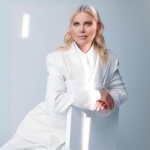
Yan Du’s YDP Brings a New Model of Art Patronage to London
Born of the vision of Chinese patron and collector Yan Du and launched a little over a year ago, YDP is an independent nonprofit project space in a beautiful townhouse on Bedford Square in Bloomsbury. Now a key platform for artists from Asia and its diaspora in London, it hosts exhibitions alongside a rich public program of talks and performances that extends its mission beyond each project, fostering broader resonance and opportunities for collaboration with institutions across the city’s diverse cultural landscape.
“I didn’t want to call it a museum or an institution because those words can sound very serious and very official. I wanted it to feel more fun and experimental,” Du told Observer ahead of a busy Frieze Week. “We begin with the individual project. That is why we call it a project space. We approach every artist through that project, which gives us the flexibility to support artists and also work with independent curators. We collaborate with different independent curators by invitation, and we also have two in-house curators. It is very much about working together and developing those relationships.”
YDP is not the first initiative Du has launched in her more than a decade of collecting and patronage; much of her earlier work was also devoted to building a bridge between her native China and the West. She has directed funds toward curators and scholarship, arguing that the underfunded part of the Asian art ecosystem was not acquisition but “the gap of research.” YDP grew out of her nearly six years with the Asymmetry Art Foundation, which she launched in 2020 to support curators working with Chinese and East Asian contemporary art. Initially nomadic and based in Hackney since 2022, Asymmetry relied heavily on partnerships to extend its impact, with initiatives ranging from fellowships at the Whitechapel and Chisenhale galleries to Ph.D. scholarships at Goldsmiths, University of London, and a lecture series with the Courtauld Institute of Art. In 2024, it also supported the appointment of two Tate Modern curators, Alvin Li and Hera Chan, so that their expertise in Asia-Pacific art could strengthen its representation in the museum’s programming. The effects have been highly visible, from Mire Lee’s memorable Turbine Hall commission to last year’s blockbuster survey of South Korean artist Do Ho Suh.

While Asymmetry focused primarily on curatorial knowledge production, supporting institutional fellowships, university scholarships and research-oriented public programs, years of working closely with curators and academics left Du wanting a more direct relationship with artists and the exhibition-making process. “After five years of working with all these curators and academics, I realized that, as a collector and philanthropist, what interested me most was also working more closely with artists in person—being part of the exhibition-making process, seeing how they develop the work and how they respond to a space and to a curatorial framework,” Du reflected. “That is why I started YDP.”
YDP appointed two prominent curators to lead the program: Billy Tang, former executive director of Hong Kong’s Para Site, as artistic director, and Erin Li, founder of Batata and former curator at Delfina Foundation, as curator of public programs and residencies. The organization’s exhibitions are usually paired with projects by artists-in-residence, with the residency program running in parallel. Jun Shen, YDP’s curator of exhibitions and research, often works with invited independent curators to keep a space open for exchange among different voices, viewpoints and practices, depending on the project. As with Asymmetry, partnerships with London’s existing cultural ecosystem are central to the model. YDP has teamed up with outside organizations on talks and public events and hosted performances developed in dialogue with locally based artists and curators. “For me, that is really about collaboration,” Du said, “rather than saying, ‘This is Asian art’ or ‘These are Asian artists.’”
Her core focus hasn’t changed: supporting artists from Asia and its diaspora, who can still feel underrepresented in a city like London compared with New York and other centers. “There are still many Asian artists who are undervalued or who have not been properly recognized by institutions and galleries. I feel there is a role I can play in introducing them, giving them a platform and supporting them,” Du explained. “I also really feel that London has a curious audience. People here are hungry for these kinds of artistic practices. The visitors are knowledgeable and sophisticated.”
Notably, YDP’s mission is tied directly to Du’s own experience of moving across cultures. “I was born and raised in mainland China, but I have lived in many different countries at different points in my life and traveled constantly,” she explained. London is now her principal home, where she lives with her husband and their children. It’s a city to which she feels a longstanding emotional connection and where she believes an initiative like YDP can still make a significant impact. “It feels very meaningful for me to establish the space here. Every day we receive an incredibly diverse audience. People walk in without even knowing who we are, and then they are surprised by what they discover,” she said. “Many visitors tell us they have not had many opportunities to see the work of Asian artists in London. They discover those artists here, and then they return. We have neighbors who come back again and again.”

Bedford Square’s associations with the Bloomsbury Group and its concentration of publishers, research centers, libraries, museums and other cultural institutions made it a particularly resonant place to establish YDP and create a site of representation for Asian art.
The organization’s building was renovated with Hong Kong-based BEAU Architects, which has designed a number of art spaces in that city. Because it is a Grade I-listed 18th-century townhouse, no structural changes could be made, resulting in what Du calls a “suitcase project” that reflects the diasporic experience of nomadic homemaking. Unfolding and adapting to each exhibition through a modular, temporary structure, the redesign brings flexibility to the original Georgian architecture while preserving its historic character and domestic intimacy. “The space still feels like a domestic house,” Du said. “It is made up of many smaller rooms. People often tell me that they feel as though they have entered a maze because every room contains different works by different artists, using different media, materials and languages.”
In the first year, the organization tested different formats. Its opening program included an exhibition by established Chinese painter Duan Jianyu—her first major solo show in the U.K. in over a decade. Spread across three floors, it featured 20 new paintings and a group of sculptures centered on the classical Chinese motif of Yúqiáo, in which a fisherman and a woodcutter appear as reclusive archetypes reflecting on human history from a contemplative distance. The exhibition ran alongside a photography presentation by Thai artist Harit Srikhao, whom Du met on a research trip two years earlier and chose as YDP’s first artist-in-residence.
Du stressed that YDP does not build its programming around a simple hierarchy of established versus emerging. What matters is balance among the practices and narratives presented, so that the space reflects the wide variety of contemporary Asian art today. “For me, it is really about balancing the practices. It is not about the artist’s generation. It is about what they do.”

Opening in time for Frieze, “true names” is a sprawling group exhibition that explores the magic of naming as an ethical practice, one that can safeguard identity while opening space for social and political negotiation and confrontation at a time when information control and algorithmic manipulation increasingly impose a one-way narrative about the self and our relationship with the world. Conceived and guest-curated by Yuan Fuca with Jun Shen, the show features a rich mix of emerging and established artists from Asia, its diaspora and beyond, including Pacita Abad, K Allado-McDowell, Bernice Bing, Chen Zhe, Stephanie Comilang, Sara Flores, Gauri Gill, Pao Houa Her, Hannah Hur, Dorothea Lange, Colectivo Los Ingrávidos, Georgia O’Keeffe, Natalia Papaeva, Abel Rodríguez, Julia Rometti & Victor Costales, Shao Fan, Võ An Khánh, Anh Vo, Zeng Xiaolian, Tuguldur Yondonjamts and alyene. Through diasporic lenses, the show explores how relations among identity, spirituality and power are mediated and regenerated, highlighting how “both diasporic and Indigenous communities have long histories of adopting, concealing, translating, reclaiming or modifying names under conditions of displacement, assimilation, and political violence,” as the curatorial essay explains.
On view in parallel is a presentation by YDP’s fall resident, Chinese artist Zishi Han, whose practice explores the relationships and tensions between the body and external structures, and between processes of adaptation and the endless possibilities of metamorphosis. Anchoring it is the nocturnal flights of stillness (2026), a recent moving-image work shown in the Artist’s Lab alongside a low, vibrating platform at the center of the space, which makes visible the seemingly invisible forces we sense before we understand them.
YDP also has a site-specific commission by Christine Sun Kim, Gappp Years (2025), conceived to resonate with themes central to YDP’s ethos, such as home, movement and dialogue, and the relationship between the self and cultural identity. Activating the reception is Danh Vo’s on-site commission and open-ended project, featuring miniature stools and a beer-garden table set that turn the area into a communal space where visitors can pause and reflect before or after their visit.
Together with Asymmetry and YDC, Du’s private collection, YDP completes what Frieze described as Du’s “perfect trinity of patronage.” Yet she says she intends to keep the three deliberately separate and distinct in how they operate. “The collection is completely separate from the project space and from our exhibitions,” she said. A dedicated team manages what now amounts to more than 800 works, maybe 900; Du no longer remembers the exact number, admitting that she collects “boldly.” Works hang throughout her home, which she occasionally opens to institutions for private visits. “I am the type of person who has to live with my collection. That is why I rehang it all the time,” she added. She also keeps the collection circulating through an active institutional loan program, lending more than 40 works last year.

She started YDP specifically to work more closely with artists and further support their careers, along with forms of practice that do not lend themselves to private collecting: “There are also so many artists whose work I love but cannot really collect. There are beautiful installations and performances, for example, that I cannot collect or live with. YDP gives me another way to support practices that do not necessarily belong within the collection.”
Rather than following a predetermined institutional model, Du sees herself as part of a younger generation of collectors still defining what cultural patronage can look like. YDP is thus both a platform for artists and an ongoing experiment in more flexible, creative models of philanthropy. “I am trying to challenge myself and challenge the traditional philanthropic model—the assumptions around what a collector should do, what a philanthropist should do and what it means to open an institution or organization,” she said.
Over time, Du has come to see how her collecting, philanthropy and personal relationships have merged into something larger. Many of the people around her are artists and curators, making it feel increasingly artificial to treat her private and professional lives as separate spheres. In London, she sees YDP’s role as fostering transcultural dialogue. “It’s incredibly international, and I have always believed in supporting and promoting transcultural dialogue,” she said. “For people like us, who come from Asian identities and backgrounds, we also want to speak. We want to share and introduce what we do and what we are passionate about, regardless of where we are.”
Rather than merely raising the visibility of Asian artists, YDP gives them space to articulate their own voices and to shape cross-cultural conversations. “It is about creating dialogue and working together. We don’t want to put Asian art into a box. Asian art is international, everyone is working together… Art is global,” Du concluded.

More in Art Collectors