‘Dreadline Express’ Game Dev On Building Apocalyptic Train Horror
For Czech developer David Konecny, Dreadline Express brings together a lifelong fascination with trains, psychological horror, and stories shaped by difficult choices. His debut game takes players aboard a train at the end of the world, where a distinctive card-based system lets them explore the lives of its varied passengers and see how their stories and fates unfold. Drawing inspiration from games like Duke Nukem 3D and SOMA, as well as films made by Ari Aster, Konecny has created an unsettling world that challenges players to trust their instincts and confront morally complicated decisions.
Below, Konecy spoke to Deadline about his journey into game development, childhood influences, and the challenge of giving players the freedom to discover its secrets.
DEADLINE: You’re a solo game developer in the Czech Republic; this is the first game that you’re putting out, right?
DAVID KONECNY: The situation is a little more complicated. It’s a solo project, but I have some coworkers who help me with art and audio because those are areas where I’m not as fluent as I’d like to be. I’m still developing the art direction, giving them concepts, drawing level layouts, and providing inspiration. Then we discuss the results. Everything comes from my head, but they help me bring it to life.
It’s my first commercial game. I’ve made some free titles, participated in game jams, and worked on a lot of projects that never saw the light of day because something always went terribly wrong and I couldn’t finish them. But, yeah, this is the first one.
DEADLINE: You’ve also been working in software development as your main job. But how long have you been making games, and how did you get started?
KONECNY: When I was little, we didn’t have computers, and I kept begging my parents to buy me magazines about games. I read about them without having any way to play them. I would look at the images and imagine how the games worked. I begged my parents to get me a computer or a game console.
I was also a tech-savvy child and interested in anything technological, so I asked them to sign me up for a children’s programming group. That’s where I gradually started to understand how things worked. I made my first little games, including text adventures in HTML. Later, I went to university to study programming and software development. That’s my career now. Thanks to games, I’m a software developer, and I think I’m a good one [laughs].
There weren’t any universities for game development at the time, so there wasn’t a way to learn it as a main career. The two big centers of game development in the Czech Republic were studios such as Altar and Bohemia Interactive, which made games like Operation Flashpoint. They were nowhere near my city, so there was no way for me to learn anything there. That’s why I started working in software development as my main career. But I always wanted to make games, and making games is different from making regular software. I kept learning about games in my free time, always creating and writing something.
Dreadline Express
Shoreline Games
DEADLINE: What games did you play growing up that influenced how you think about game development?
KONECNY: The good thing was that every computer lab had a bunch of games installed on the computers. When the teacher wasn’t looking, we were all playing. I remember Warcraft II being a regular choice, but probably the most influential game for me was Duke Nukem 3D.
I really loved the world and all the little details that made the experience feel real. When you killed a monster, and it was under those doors that opened and closed, the door would crush the monster. When it opened again, you could see its innards stretched across the door. It was an immersive experience for me. I thought, “This is the best we can get. The game cannot be more realistic than this. This is it, guys. This is the stuff.”
I also loved how some levels changed. There was a level where you had to start a demolition, and the whole building collapsed, opening a new way forward. That was so innovative to me. Those experiences stayed with me, and I want to create a world that feels alive and real. That was huge for me.
DEADLINE: Let’s talk about Dreadline Express. It’s a train at the end of the world. When we spoke at Gamescom, you mentioned that people had compared it to Snowpiercer, although that wasn’t necessarily an inspiration you had in mind. Where did the idea originate, and how long had you been thinking about it?
KONECNY: There are a lot of inspirations, but I like trains. I think it all began when my great-grandmother used to take me to watch trains while she was looking after me. We’d go to an overpass and watch them from above. That’s one of my core memories.
The game itself came about during a period when I was having a crisis in game development. I stopped making games for two or three years and started writing short stories and novels. Nothing was ever published, but I was developing these stories, and eventually I came up with one about this train. I love trains, and I love Lovecraft. I also wanted to incorporate a totalitarian regime because it’s something that’s in our DNA as Czechs.
I put all these elements together and realized I wasn’t sure how I wanted the story to unfold, because everything seemed interesting and there were so many possible directions. The only logical decision was to make it a game so players could decide which path to take and which character’s story interested them most. That was the beginning of Dreadline Express. The card mechanics came later, and that’s a completely different story.
DEADLINE: Talk about the card mechanics. Players have a lot of control over what they discover, and this system is a distinctive way to approach storytelling. Why did you decide to use cards?
KONECNY: Originally, it came from Steam Trading Cards, the cards you get for playing games that you can sell or combine. It’s a dopamine mechanism that Steam has built in. I always found it a little strange. I wondered, “Why is it there? I’m playing games, and I don’t need another reward for playing because the game itself is a reward.” It’s not like you’re doing your taxes and get a card. That would be cool, actually. If you filled out your taxes and got something, that would be nice [laughs]. I started thinking about how to take these cards, which people obviously love collecting, and turn them into a proper game mechanic. Completing a full set feels good, but I wanted the cards to give players more than the satisfaction of unlocking something. I wanted them to provide options. That’s how the idea was born.
I wanted to create a gameplay loop where you get a card, discover something, and immediately start thinking: “OK, I have this new item, this new thing. How can I use it? What can I combine it with? What possibilities will it open up for me?”That’s why I chose cards. They’re cool; they let us create really nice illustrations, and a lot of love goes into them.

Dreadline Express
Shoreline Games
DEADLINE: Let’s talk about the art design, both the cards and the game itself. The characters have these angular pixelated features that give them an unsettling quality. What look were you and the art team going for, and why?
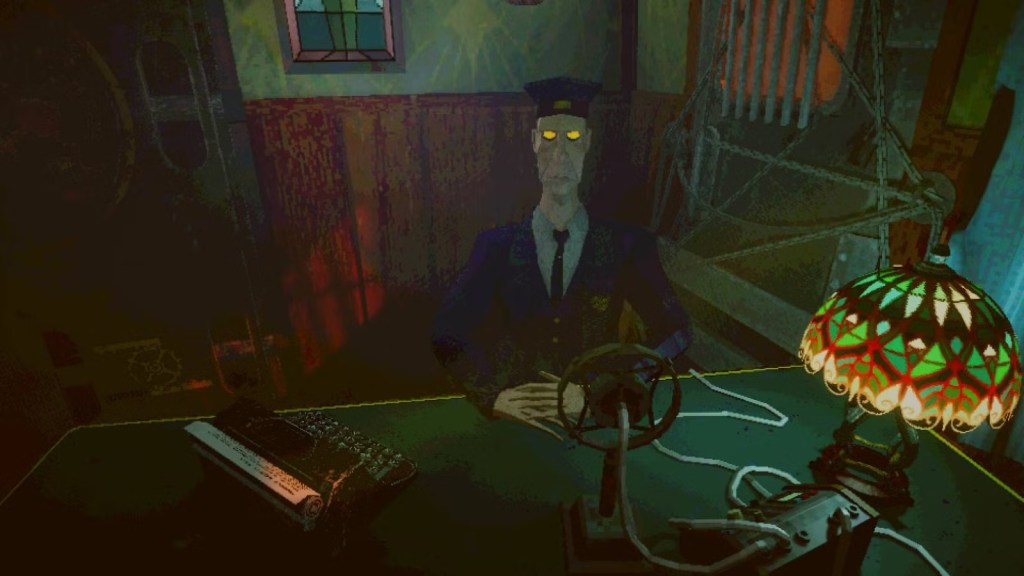
KONECNY: One consideration was that we’re not a huge team with a huge budget, so we need to make things quickly and work within our limitations. This PS1-style, low-resolution, pixelated graphics approach is great for horror because it leaves something to the player’s imagination. It suits these stories much better than photorealistic graphics do because players can fill in the gaps, making the experience more immersive.
I also really wanted the characters to be distinctive, so we went a little over the top with their designs. We gave them really sharp features, which become even more pronounced with that low-resolution style. You really see those edges, and that makes them more memorable. I wanted the characters to be a little horrifying. The idea was to show how the train had taken something from them, a part of their humanity. They’re sitting there, and you can see how crumbled they are and how they don’t blink.
DEADLINE: They look a little gothic and spooky. What did you want players to feel when they first encountered these characters?
KONECNY: I wanted players to feel a little afraid of the characters when they first meet them, when they stare at you with those dead eyes. Then, as you start talking to them and gradually understand their stories, I wanted you to find your way toward them. You might initially feel repulsed by them or genuinely afraid, but eventually you might feel sorry for them or find some connection with them.
DEADLINE: What other games, films or filmmakers influenced the horror in Dreadline Express?
KONECNY: I really love good psychological horror. Off the top of my head, I can think of Ari Aster’s Hereditary and Midsommar. The Menu is also great horror. I like it when it’s about the story rather than jump scares or a monster that’s simply bad because it’s bad. I love it when everything has layers.
We have antagonists on the train, of course, but even they have their own stories. I love the ambiguity of it, where nothing is entirely good or bad, and you have to decide for yourself. Another example is Hellraiser, because I really love the Cenobites. They’re not bad guys. They want to show you something incredible from their perspective, but it might not be so incredible for humans. It’s really interesting to look at something from different points of view. The psychological aspect is even more interesting than the body horror. If you look at something from different perspectives, it becomes really compelling. That’s what I wanted to put into this game.
In terms of games, Frictional Games is probably my favorite horror studio, especially because of SOMA. It’s psychological horror, and it connects to some of your internal fears. It makes you think about your life in different contexts. For me, it was a life-changing experience. I always wanted to make something that could stick in people’s minds and make them think about the game or the story after they finish it. That’s really important to me.
Dreadline Express
Shoreline Games
DEADLINE: What was the biggest challenge in developing the game, whether narratively, in terms of level design or otherwise?
KONECNY: The first thing is that I’m making a horror game in which you cannot die. That’s unusual compared with games like Resident Evil, Silent Hill and Dead Space. The biggest challenge, though, is that I’m putting a lot of trust in the player. I let them discover clues and figure out how to play for themselves. That’s a big part of the experience. Players need to feel clever, like, “I did this. I figured it out. The developer didn’t tell me anything, and I managed to find a way.”
It’s hard to strike the right balance. You want to provide just enough clues without making things too obvious. That was a huge challenge. I traveled with the game to different conventions and game development events for a year and a half, collecting data and asking people questions to find the right balance. That was a huge part of development. I hope I nailed it, but we’ll see.
DEADLINE: What do you hope players take away from Dreadline Express?
KONECNY: I hope they find a game that values their time, doesn’t overstay its welcome, and gives them exactly the experience they want to have. I’m especially looking forward to seeing players talk to each other about their different experiences with the game. I hope it creates conversations and discoveries, maybe even brings some people together. I’m excited about that sense of discovery.
Maybe someone will learn something about themselves based on the choices they make, who they sacrifice, or how they approach different situations. I think we have something quite big prepared for the ending, and I hope as many people as possible will really appreciate it. Maybe if it makes someone cry, I’ll be happy [laughs].
Dreadline Express is now available on Steam.