Trump’s Approval Rating Flips With Rural Voters Before Midterms
President Donald Trump’s approval rating among rural voters in the likely electorate reached 50 percent in an Echelon Insights poll conducted October 15 to 19, putting him one point above water after a steep September decline.
Trump’s rural net approval rating (those who approve minus those who disapprove within this subgroup) fell seven points in Echelon Insights surveys published between June and July before partially bouncing back in August, although smaller demographic samples are less precise than the overall electorate surveyed.
The broader electorate Echelon polled remains unfavorable to Trump, with 39 percent approving and 60 percent disapproving in the latest poll, while Democrats lead the generic congressional ballot by five points.
A stronger rural mood in states with competitive midterm races such as Iowa, Kansas and Alaska may help Republican campaigns across the heartland, but voters can approve of the president without supporting his party’s local nominee.
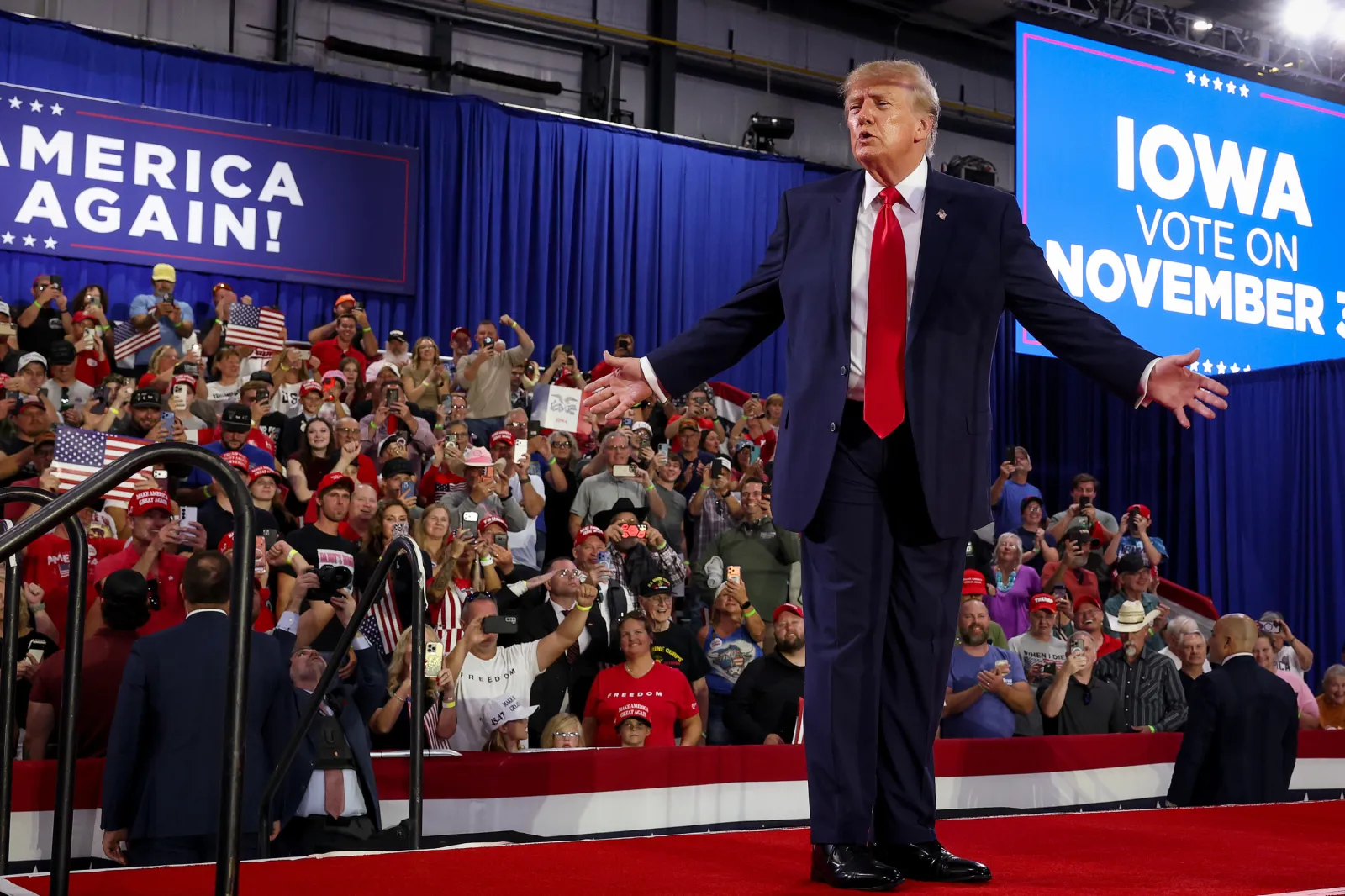
It comes as Trump rallied Republican voters in Sioux City, Iowa, on Thursday, urging them to back GOP candidates in the November 3 midterms as part of his campaign tour around the country to try to give a boost to Republicans in tight races.
At the Sioux City rally, Trump urged supporters gathered at an airport hangar to “pretend I’m on the ballot, because if you get out, we’re going to win big.”
Why It Matters
Midterm elections historically punish the president’s party, leaving Republicans vulnerable as they defend their congressional majorities, and raising the stakes in agricultural states where household budgets, fuel bills and farm income can outweigh national loyalties.
Republicans Face Pressure Across Rural States
Trump’s rural recovery coincides with an Emerson College Polling survey, which put Republican Ashley Hinson two points ahead in Iowa’s Senate race, while an earlier Marist Poll gave Democrat Josh Turek an eight-point advantage.
Iowa’s economy was the leading concern for 42 percent of voters in Emerson’s October survey.
Hinson has criticized the administration over the Iran war and its approach to beef tariffs, saying Iowans “shouldn’t have to foot the bill at the pump or the checkout line” while farmers and ranchers face higher costs.
Her approach seeks to retain the president’s supporters while showing independence on issues affecting rural livelihoods.
Republicans are also fighting unexpectedly close Senate contests in Kansas and Alaska, widening the number of rural states where the party cannot take its traditional advantage for granted.
Kansas has not elected a Democratic senator since 1932, yet Republican Roger Marshall is locked in a competitive race with Democrat Adam Hamilton.
Alaska has emerged as another Republican pressure point, with Mary Peltola challenging Senator Dan Sullivan amid widespread concern about fuel, utility and grocery bills.
Current polling averages put Democrats narrowly ahead in both states, although individual surveys remain close and their estimates vary.
Rural Approval Recovers From September Low
The Echelon series shows Trump beginning the summer in June with 51 percent approval and 48 percent disapproval among rural voters, a net rating of plus three.
July reversed that balance, with 47 percent approving and 51 percent disapproving.
August brought a narrower deficit of 49 percent to 50 percent before September produced the weakest result in the sequence: 40 percent approval against 59 percent disapproval.
October’s 50-to-49 reading therefore represents a 20-point improvement in net approval in one month.
That is a striking movement, although it should not be read as proof of a durable realignment.
Subgroup figures can fluctuate more sharply because they are based on fewer interviews, and a one-point advantage is too narrow to establish that rural opinion has decisively changed.
Echelon surveyed 1,010 voters in the likely electorate from October 15 through 19. The full sample had a margin of sampling error of plus or minus 3.6 percentage points.
Economic anxiety offers context for the rural change.
Echelon reported that 74 percent of voters believed ending the Iran war would help reduce the cost of living, while the same share selected cutting government spending.
Rural States Test Whether Trump Support Transfers
The distinction between presidential approval and candidate choice is particularly important in Iowa, but the same problem confronts Republicans elsewhere in rural America.
Emerson College Polling’s survey, conducted October 5 and 6 among 650 likely Iowa voters, put Hinson at 47 percent and Turek at 45 percent.
Libertarian Thomas Laehn received 2 percent, while 7 percent were undecided.
Its margin of error was plus or minus 3.8 percentage points, leaving the leading candidates statistically inseparable.
Marist found a contrasting result in interviews conducted September 17 to 20. Its survey of 1,050 registered voters gave Turek 50 percent and Hinson 42 percent, with a margin of error of plus or minus 4.4 percentage points. Forty-six percent said their family finances had deteriorated during the previous year.
Marist surveyed registered voters, while Emerson modeled likely voters closer to Election Day; turnout assumptions can change the composition of a close race.
A more surprising contest has developed in neighboring Kansas, where incumbent Marshall faces Hamilton, a United Methodist pastor who has made living costs and the Iran war central to his campaign.
An Emerson College Polling/Nexstar Media survey conducted September 15 and 16 among 750 likely voters placed Hamilton at 45 percent and Marshall at 43 percent.
Libertarian David Graham had 4 percent, with 8 percent undecided.
The poll carried a margin of error of plus or minus 3.6 percentage points, meaning neither major-party candidate held a statistically significant lead.
That survey also found Trump underwater statewide, with 40 percent approving of his performance and 53 percent disapproving.
The economy was the leading issue for 48 percent of respondents, while Hamilton led among independents by 15 points.
Those results help explain why Marshall, a presidential ally, has emphasized protecting Kansas agriculture and the cattle industry while acknowledging disagreements with the White House.
Alaska presents another warning for the GOP.
Sullivan is defending a seat in a state Trump carried by 13.1 points in 2024, yet recent polling has shown Peltola narrowly ahead.
A Data for Progress poll conducted October 8 to 16 among 694 likely voters gave Peltola 51 percent and Sullivan 49 percent in a head-to-head contest.
Its margin of error was plus or minus 4 percentage points, placing the difference inside the survey’s uncertainty range.
Nebraska is a less immediate Democratic opportunity, but its Senate race has also forced Republicans to defend normally reliable territory.
Forecasts continue to favor incumbent Republican Pete Ricketts over independent Dan Osborn, although public polling has repeatedly shown a considerably closer contest than Nebraska’s strong Republican history would suggest.
Sabato’s Crystal Ball moved the race toward greater competitiveness on October 14, downgrading it from “Likely Republican” to “Leans Republican” while continuing to favor Ricketts.
The White House Points To Trump’s Coalition
Davis Ingle, a White House spokesman, told Newsweek in an emailed statement that Trump had created “one of the most robust coalitions in political history” and remained the Republican Party’s “best messenger.”
Ingle cited tax cuts, lower prescription-drug costs, border enforcement, private-sector job growth and rising retirement accounts as evidence for the administration’s case, adding that Trump was committed to preserving Republican majorities in Congress.
What Happens Next
The final weeks will test that claim at the ballot-box level.
Rural approval has recovered, but Republicans still need voters who feel warmly toward the president to turn out, choose his party’s candidates and overlook disagreements over policies affecting their own farms and household budgets.
Newsweek’s reporters and editors used Martyn, our AI assistant, to produce this story. Learn more about Martyn here.
Contact Newsweek editor on this story: Edward Pearcey.