

4 Giant T. rex Footprints Found in North Dakota May Reveal How the Dinosaur Walked
Four giant three-toed footprints believed to have been left by an adult Tyrannosaurus rex were discovered in 2025 near Marmarth in southwestern North Dakota after high school teacher and amateur fossil hunter Kent Hups spotted a strange wedge-shaped formation while volunteering at a paleontological dig. Researchers later found three additional footprints at the site, forming a roughly 23-foot-long trackway dating to about 66.5 million years ago.
The discovery, detailed in a study published Sept. 8, 2026, in the Journal of Vertebrate Paleontology, could represent the first known trackway made by an adult T. rex. The sequence of footprints gives scientists something a skeleton cannot: evidence of the dinosaur actually moving across its environment, including clues about its walking speed, foot structure, and behavior.
Teacher spotted the first footprint during a dig
Hups was volunteering on a fossil excavation led by Tyler Lyson, senior curator of vertebrate paleontology at the Denver Museum of Nature & Science, when he noticed something unusual protruding from the ground.
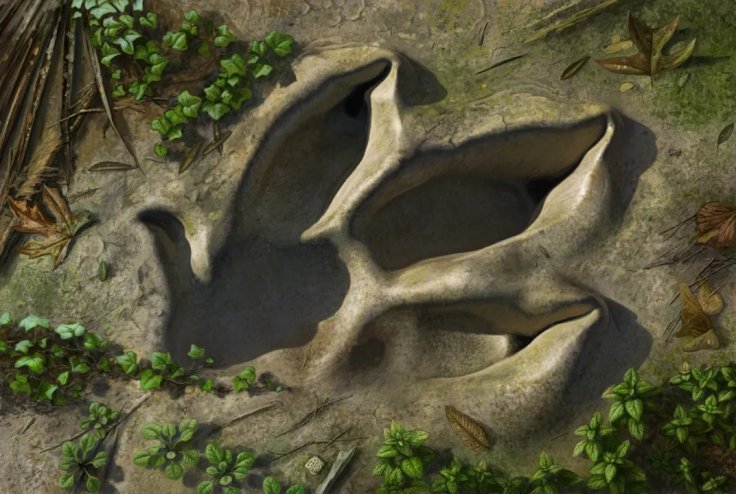
The feature had a lumpy, wedge-shaped appearance with three sections spreading outward. Hups recognized the shape as potentially belonging to a three-toed dinosaur and alerted Lyson.
The researchers were initially cautious because confirmed adult T. rex footprints are extremely rare. Before this discovery, only two adult T. rex tracks had been reported, one in New Mexico and another in Montana.
Tyler Lyson/ Smithsonian Magazine
The team returned to the site the next day and found more evidence. In total, they documented four large footprints, with two left and two right footprints arranged along a trail.
Each footprint measures about 3 feet long.
The arrangement of the tracks allowed researchers to study the distance between the dinosaur’s steps rather than examining an isolated impression.
Hups said the discovery reflected the importance of paying attention to unexpected details during fieldwork.
“As a teacher, I’m always telling my students that science starts with curiosity, passion, and careful observation. I never imagined that could lead me to a discovery like this,” Hups said in a statement from the Denver Museum of Nature & Science.
The tracks show how fast the T. rex was walking
The distance between the footprints provides clues about the dinosaur’s movement.
Using the footprint and stride measurements, researchers estimate that the T. rex was traveling at approximately 3.4 to 4.5 mph.
The evidence points to a walking animal rather than one moving at a high-speed run.
One footprint also appears to contain an impression from one of the dinosaur’s claws, giving researchers another feature to examine as they study how the foot interacted with the ground.
Scientists identified the tracks as likely belonging to T. rex based on their size, shape, and location.
Andrey Atuchin/ Smithsonian Magazine
The site lies within the Hell Creek Formation, a geological region covering parts of North Dakota, South Dakota, Montana and Wyoming that contains fossils dating to the final portion of the Cretaceous Period.
The formation is particularly famous for T. rex fossils. Among the discoveries from the region are Sue, one of the most complete T. rex skeletons ever found, and a juvenile known as Teen Rex.
Why did the footprints survive for 66 million years?
The location where the dinosaur walked was not necessarily a good place for footprints to survive.
Around 66.5 million years ago, southwestern North Dakota was a wet, floodplain environment crossed by streams. Footprints made in soft ground could have been washed away or destroyed relatively quickly.
Researchers believe a rare combination of conditions may have preserved these particular tracks.
Their leading explanation is that water containing bacteria flowed into the footprints after they were made. Dissolved minerals in the water then accumulated inside the depressions.
As sediment and minerals continued to build up, the material filling the footprints became harder than the surrounding mud.
Over millions of years, erosion removed the softer material around the hardened track fills. The result is unusual: the footprints now appear as raised, three-dimensional casts rather than as depressions in the ground.
That unusual preservation may have allowed the short sequence of T. rex steps to remain visible long after the surrounding landscape disappeared.
Why a T. rex trackway matters
A dinosaur skeleton can reveal the size and shape of an animal’s bones, but footprints provide information about movement.
A sequence of tracks can show the spacing of steps, the direction of travel, and aspects of how an animal placed its feet while walking.
That makes a trackway particularly useful for studying T. rex, even though only four footprints were found.
Lyson said the difference between skeletal fossils and footprints is especially important for understanding dinosaur behavior.
“Bones tell us an enormous amount about these animals, but footprints capture a moment of behavior,” Lyson said in the museum statement. “With a trackway, we can actually follow an animal as it moved across the landscape. That is incredibly rare for T. rex.”
The researchers are now preserving the physical tracks while also creating detailed digital records.
Three of the footprints were covered with protective plaster and burlap before being prepared for helicopter transport to the Denver Museum of Nature & Science. The tracks were found on federal land managed by the U.S. Forest Service, and the researchers received permission to collect them.
Before removing the fossils, the team also produced high-resolution scans that can be used to create digital 3D models.
Those models could allow scientists to examine the footprints from different angles and compare them with other dinosaur tracks. Researchers may also be able to look for additional details, including possible impressions of skin.
A rare window into the life of T. rex
The discovery does not provide a complete picture of how T. rex moved, but it adds an unusual type of evidence to the fossil record.
The four footprints preserve a brief moment when a large predator crossed a wet landscape near the end of the dinosaur era. Their spacing provides an estimate of its walking pace, while the shape of the tracks offers clues about its feet.
Hups said the significance of finding something so rare was difficult to imagine before the discovery. “Everybody hopes that they find that thing: You find a complete T. rex, or you find something that is just incredible to see,” he told National Geographic. “But you never think you’re going to find something that is the only one in the world.”
The researchers’ continued study of the physical tracks and their 3D models could reveal more about the dinosaur’s movement and foot anatomy. If additional preserved details are found, the fossils could provide an even closer look at a T. rex walking across North Dakota roughly 66.5 million years ago.
