

New Egg-Eating Snake Species Discovered in Ethiopia’s Harenna Forest
A new species of egg-eating snake has been formally described from Ethiopia’s Harenna Forest after researchers spent seven years studying specimens, breeding them in captivity, and comparing their DNA with closely related snakes.
The species, named Dasypeltis albigularis, was first identified as a juvenile female collected in the forest on May 30, 2019, and was initially mistaken for the closely related Dasypeltis atra.
The snake, known as the White-throated Egg-eater, is a harmless species that lives in dense forest between about 1,500 and 1,700 meters above sea level. Its discovery shows why some snake species can remain hidden in plain sight, particularly when their appearance is very similar to that of known relatives. Genetic, physical, and breeding evidence eventually showed that the Harenna Forest population represents a separate species.
A snake that initially looked like a known species
The investigation began when Arthur Tiutenko, the study’s first author, received a juvenile female egg-eater from a local collaborator in Harenna Forest in 2019.
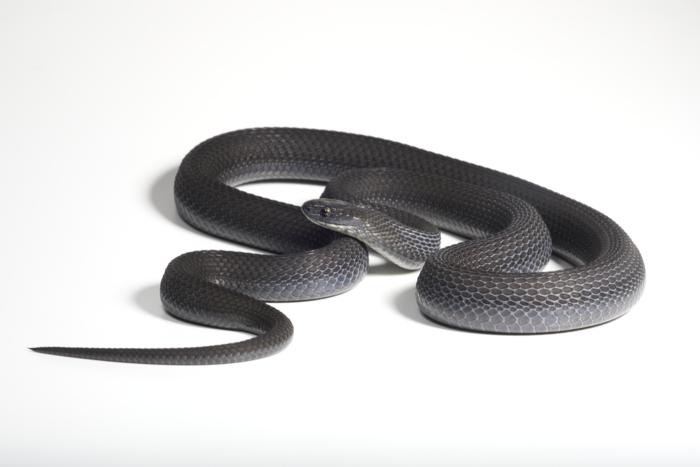
At first, its mostly black appearance suggested D. atra, commonly known as the Montane Egg-eater. But as the snake grew, Tiutenko noticed features that did not quite match the known species.
The differences included its bluish-looking skin between the scales, white coloring beneath the head and on the front part of the belly, and unusual scales on its head. The first specimen also had a small scale that is generally absent in egg-eating snakes.
The unusual combination prompted Tiutenko to investigate whether the snake represented more than a variation of D. atra.
Abdulkadir M. Hussein
The study eventually examined 16 specimens from the Harenna Forest, including six males and 10 females. The researchers compared their physical characteristics with other Dasypeltis snakes and also analyzed genetic material.
A snake that initially looked like a known species
One of the unusual parts of the investigation was that researchers did not rely only on photographs, measurements, or DNA.
After the Harenna female reached sexual maturity, Tiutenko bred her with a male D. atra from Mount Kenya. The mating took place in July 2022. The resulting offspring showed characteristics from both parents, giving researchers additional information about how the unusual traits were inherited.
The experiment became part of a much longer investigation.
According to the research paper, the study took seven years, with observations beginning in June 2019. Researchers monitored the behavior, seasonal activity, and breeding biology of Harenna Forest snakes in captivity while also studying other Dasypeltis species for comparison.
Tiutenko explained how the discovery developed from an initial assumption that the snake was already known.
“I received a juvenile female of an egg-eater that appeared to me to be an already known species, and I started looking for a male to breed it,” he said. “As she grew to adult size, I noticed morphological differences.”
DNA confirmed a separate species
The researchers then turned to molecular evidence to determine whether the differences were enough to classify the Harenna population as a separate species.
For the first time in a Dasypeltis study, the researchers used a combination of mitochondrial and nuclear genetic markers. Their analysis placed the Harenna Forest snake as a sister species to D. atra, meaning the two are closely related but represent separate evolutionary lineages.
The genetic distance between the Harenna population and D. atra was comparable to, or greater than, differences found between some species already recognized within the genus. The Harenna snakes were also geographically and ecologically separated from their closest relatives.
Arthur Tiutenko et al., 2026.
The researchers concluded that the population is evolving separately and formally described it as Dasypeltis albigularis.
What makes the white-throated egg-eater different?
The new species can reach about 92 centimeters in total length, with females larger than males. Males can reach less than 60 centimeters.
Most individuals are dark gray or black on top, although some have brown or reddish-brown patterns. The feature behind the species’ name is the pale coloring around the throat and the front portion of the underside.
The snake also has light gray skin between its scales that can appear bluish, particularly in adults. Its first rows of body scales are smoother than those of several related species.
Another unusual feature concerns defense. Several Dasypeltis species can rub specialized scales together to produce a rasping sound when threatened. Researchers observed no such sound production in D. albigularis, and its relevant scales appear less suited for this behavior.
An egg-only diet in a forest habitat
Like other egg-eating snakes, D. albigularis has a highly specialized diet. It feeds on bird eggs rather than hunting and eating birds or other animals.
The species occurs in the Harenna Forest, one of the remaining areas of natural forest in the Horn of Africa. The documented population lives on the forested slopes of the Bale Mountains at elevations of roughly 1,500 to 1,700 meters.
The researchers found that the snake’s breeding cycle also appears connected to the seasonal availability of bird eggs. Females can produce several clutches, while eggs generally hatch after about three months of incubation.
The discovery also suggests that the number of recognized Dasypeltis species could continue to change. Researchers note that some snakes previously grouped together because they share a plain black or brown appearance may actually represent separate species.
For Tiutenko, the Harenna snake is one of a growing number of taxonomic discoveries. He said D. albigularis is the 20th taxon he has named and described, with several more potential species still awaiting formal publication.
