A look inside the “lost” U.S. city brought back to life after 120 years
San Francisco—one of America’s great Gilded Age cities that was devastated by a deadly earthquake in 1906—has been reimagined in new renderings capturing what the Californian metropolis could have looked like today had it never been hit by the disaster.
The city was brought to life in a series of images created by journalist and architectural enthusiast Daniel Coughlin, who has recreated various unrealized urban developments on his YouTube channel, The Curious Compendium of Architectural What-Ifs.
His latest renderings of a re-envisioned San Francisco were published this week in a documentary video titled, “What if the 1906 earthquake had never destroyed San Francisco?”
“The documentary reconstructs the extraordinary city that vanished in the disaster, from the lost mansions of Nob Hill and the original Palace Hotel to Old City Hall, Chinatown, and the grand buildings of Market Street, then places them back into a living, present-day San Francisco,” Coughlin told Newsweek.
The tremor on April 18, 1906, was shorter than a minute but set off fires that scorched San Francisco for three days, according to the National Archives. About 3,000 people were killed, hundreds of city blocks were leveled and half of the city was left homeless.

San Francisco as Never Seen Before
Coughlin used extensive historical research to create an “alternate San Francisco that has never been visualized in this way before.”
The biggest challenge in the project was to make the recreation feel historically convincing in its details, from the colors and textures of the restored buildings down to the correct street furniture for the modern street scenes.
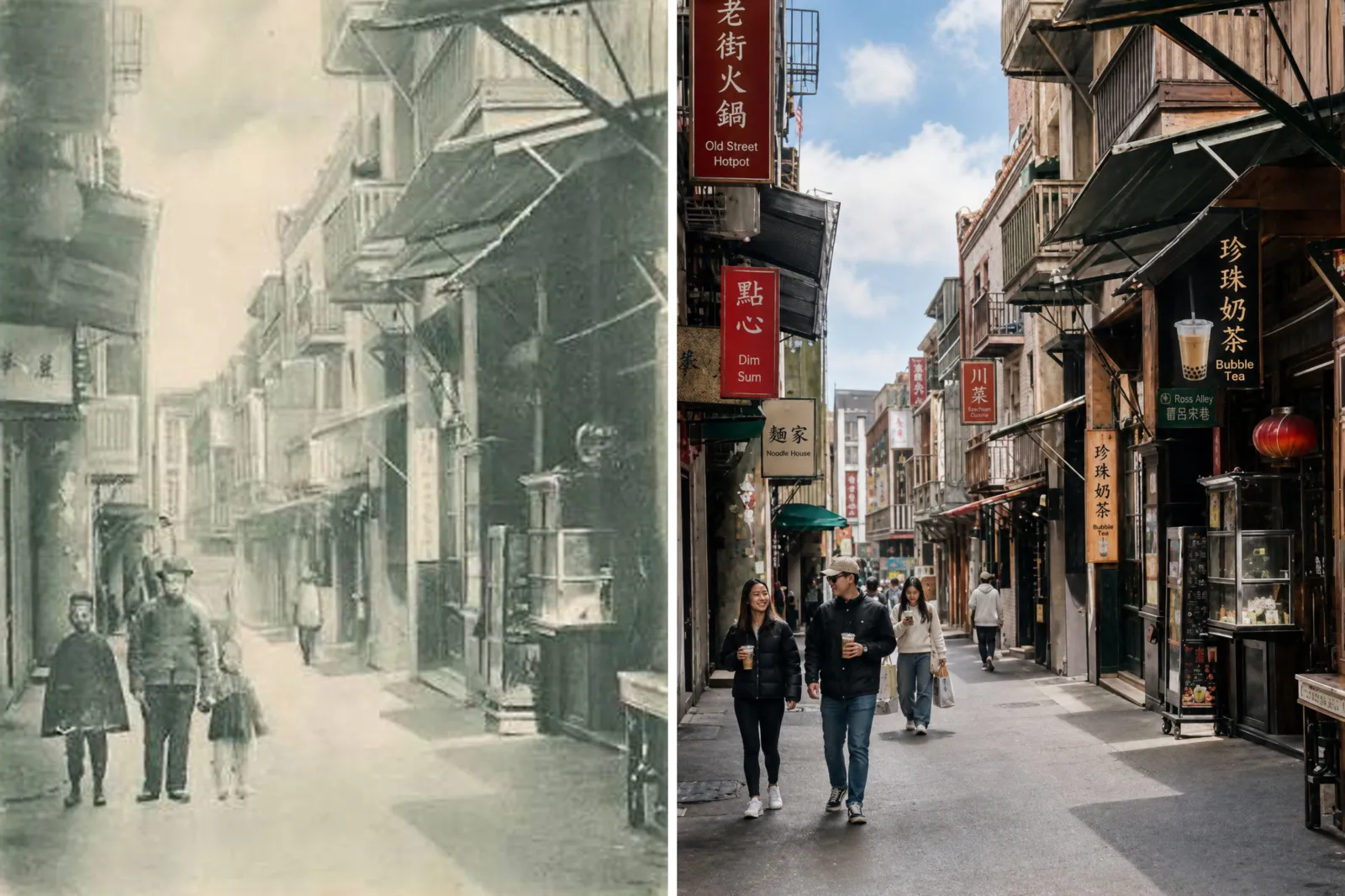
Coughlin’s work is based on a review of extensive period photography, architectural drawings, and contemporary descriptions, which were cross-referenced where possible so that features such as building materials, proportions, rooflines, façades, street layouts, and neighboring structures were as accurate as possible.


“I read accounts of the disaster, pored over descriptions of the lost buildings and studied maps, including pre-1906 street maps and post-disaster damage maps,” he told Newsweek. Coughlin also studied the city’s modern road layout as well as up-to-date images and current maps of the city to ensure the placing of the buildings was accurate.
Coughlin didn’t want to simply “colorize the heritage buildings and plonk them into 21st century San Francisco.” Instead, he aimed to imagine how these structures might have evolved over the past 120 years, including how they would have been maintained, adapted, and used, and sit naturally within the modern city today.

‘One of America’s Great Historic Architectural Cities’
The remake of Nob Hill may be one of the biggest surprises for viewers, Coughlin said, in which he created “a majestic skyline that has largely vanished from people’s memory.” Before the 1906 disaster, Nob Hill was “dominated by extraordinary mansions belonging to some of California‘s wealthiest families, along with soaring church spires and the glistening domes of the Temple Emanu-El,” he noted.
Another “spectacular loss” was the incredible old City Hall, along with the original Palace Hotel and much of the elaborate commercial architecture around Market Street, Coughlin said.
He also highlighted that “Chinatown is especially fascinating because the pre-earthquake district had a very different architectural character from the neighbourhood that emerged after the disaster, more Italianate and less Chinese-influenced, though with authentic Cantonese details.”


Had the earthquake in 1906 never happened, Coughlin believes San Francisco would be viewed “even more strongly as one of America’s great historic architectural cities.”
He says areas such as Market Street and Nob Hill could have been comparable to some of the incredibly well-preserved historic districts we see in Europe today.
While San Francisco in its current form is unmistakably beautiful, with its wealth of existing heritage buildings, had “so much of its 19th-century fabric survived, there would be a much clearer visual continuity between the Gold Rush era, the Gilded Age and modern San Francisco,” Coughlin said.


Do you have an architecture or design-related story to share? Let us know via s.kim@newsweek.com, and your story could be featured by Newsweek.
Contact Newsweek editors for this story: Sirena Bergman and Anthony Murray.