AI Revolution Helps Fuel Surge In US Small Business Formation
Heather Diehl/Getty Images
KEY POINTS
- U.S. employer business formation is projected to reach record levels, with nearly 29,700 new businesses expected each month.
- Startups are leveraging AI to automate legal work, marketing, and web design, allowing tiny teams to achieve the output of larger businesses.
While professional economists remain divided about whether AI creates more jobs than it destroys, data from the U.S. Census Bureau indicates that small business creation is breaking records.
Approximately 29,700 new employer businesses are expected to form each month nationwide over the next year, a 17% increase compared to 2025 estimates.
The surge is particularly notable in knowledge-intensive industries that increasingly rely on the use of AI tools, say analysts.
Businesses in professional, scientific and technical services such as legal, architectural and advertising firms are forming at a rapid clip of more than 5,000 companies per month, a 24% year-over-year increase. Since the launch of ChatGPT in 2022, new business filings in professional services grew four times faster than in construction according to reporting by Bloomberg.
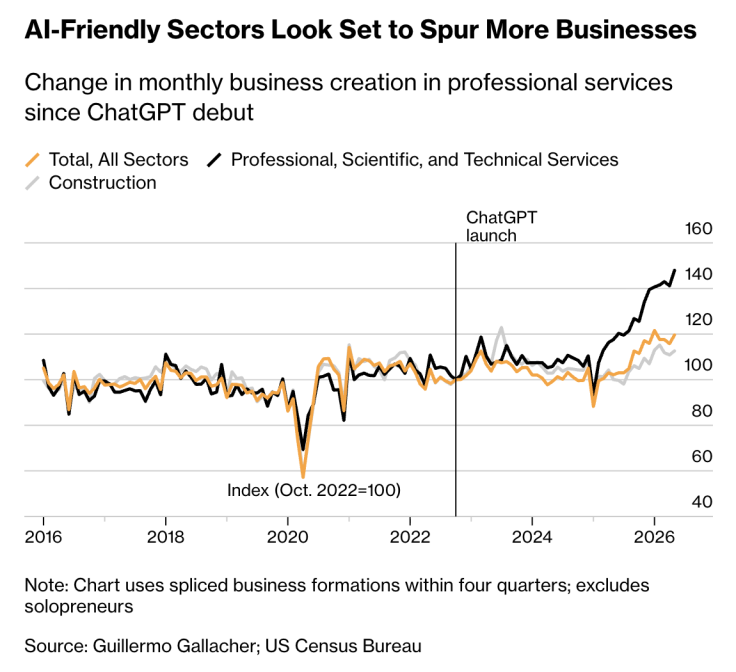
Bloomberg
“We’ve never created as many businesses,” said Apollo Global Management’s Chief Economist Torsten Slok. “It does tell you that AI is playing a very big role.”
Economists attribute this startup boom to AI lowering not just costs but legal and administrative hurdles as well. AI-powered software can assist with legal documentation, accounting, marketing, customer service, software development and website design, allowing founders to build businesses with leaner teams than in the past.
Robbie van Zyl, founder of Atlanta-based Askari Defense Inc., described AI as his defense startup’s entire back office, calling it “the next-generation force multiplier for small businesses.”
Lower barriers to entry may mean some weaker business models move forward and fail quickly. However, many economists expect the growing pace of new business creation will ultimately produce a larger number of successful companies over time even if failed ventures also increase.