At the epicenter of AI, San Francisco Bay residents take on the technology
San Francisco Bay Area residents, living in the beating heart of the artificial intelligence boom, are just as conflicted about the technology as the rest of the country.
As OpenAI showed off its latest AI assistants in San Francisco last week, protesters outside — some dressed as killer robots —demanded it keep AI away from the military. Thirteen miles away in Oakland the following day, some senior citizens sat down with a group of students to address AI angst at a grassroots tech event.
Even as the clash between tech titans and anxious activists intensifies, the debate about AI is increasingly permeating community events, with the young and old grappling with the changes AI is bringing to their cities and the world.
Many are confused and want answers.
Oakland resident Assata Olugbala, 81, asked for help removing Google’s AI bot Gemini from her devices after it started offering help she hadn’t requested.
“I’ve never invited it into my space,” she said. “But it starts talking to me and answering questions.”
While debates about building AI that surpasses human intelligence, flashy new gadgets and AI spending tend to dominate tech events, tech talks at last week’s Oakland Tech Week often had a different vibe.
The citywide annual event aims to bring technology to everyday consumers and constituents, and AI was one of its biggest concerns.
The event, which ended Saturday, featured panels and workshops titled “How to build Socially Responsive AI,” “AI in the workplace,” “Can AI Heal Us?” and “Master the Machine.”
Companies based around the San Francisco Bay Area, including OpenAI and Meta, have promoted AI assistants as friendly, cute helpers for tackling tedious tasks. But tech workers, activists and politicians fear that humans could lose control of the technology they’re advancing.
Anxiety about AI’s potential dangers surged last month after Anthropic researcher Jacob Coxon resigned, posting on social media that AI companies, including OpenAI, are “gambling with our lives.” Executives and AI companies have called for a slowdown in the technology’s development, and policymakers have been scrambling to add more guardrails.
Early last week, President Trump and tech executives from Anthropic, Google, Meta, OpenAI, Nvidia and others signed a voluntary accord to “self-police” AI development.
In California, Gov. Gavin Newsom has signed several bills to make AI safer for children and workers. He also issued an executive order to speed up the development of safeguards, including a “kill switch” in case humans lose control of AI.
“AI should expand opportunity — not come at the expense of workers and families,” Newsom said last month in a statement.
At the OpenAI developers’ conference, held at a former military base in San Francisco, the company’s chief executive, Sam Altman, expressed hope.
AI protesters gather outside the OpenAI DevDay 2026 conference in San Francisco, on Tuesday, Sept 29, 2026.
(AP Photo/Josh Edelson)
“I believe that the future, if we get this right, can be much more like a new renaissance than a new industrial revolution,” he said on stage. “AI should be about giving people more power over their own lives, more tools to create, learn, discover, expand knowledge.”
Outside, dozens of protesters held up signs that read “No Killer Robots for ICE,” “People over AI” and “Where is your moral codex?”
They demanded an end to AI surveillance and lethal autonomous weapons, as well as soaring San Francisco rents.
“Sam Altman, get off it. Put people over profit,” protesters chanted.
Berkeley resident Matt Nichols came to the protest dressed up as a killer robot holding a chainsaw. “AI is being used to move us toward a surveillance state with no accountability,” he said.
Lucas Lu walked by the protest, guiding two black-and-white humanoid robots. His employer rents out the robots for events such as OpenAI’s conference. He led them away from the vocal crowd.
Although some people fear AI because they’re worried it could lead to killer robots like those in “The Terminator,” Lu said AI can be helpful.

Norman Weekes teaches AI to seniors participating in tech week at Mills College at Northeastern University in Oakland.
(Paul Kuroda/For The Times)
“It’s actually good at research,” he said. “But I won’t depend on AI to make any decision for me.”
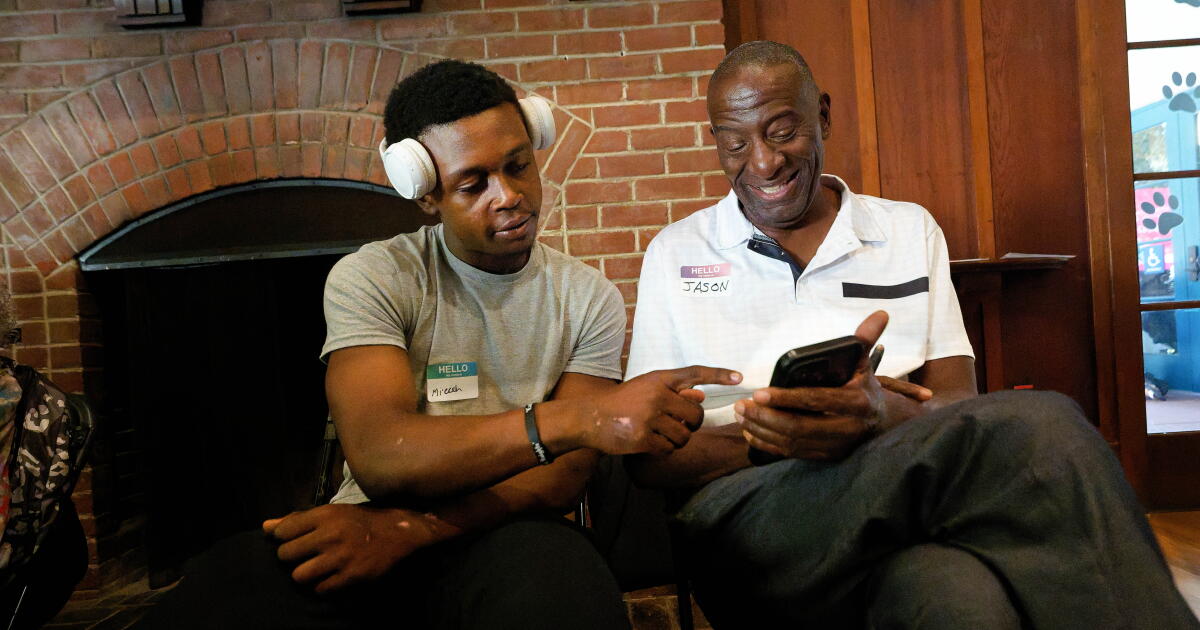
In Oakland, in one event held at Mills College — part of Northeastern University’s global system — titled “Senior Technology Day: Lifelong Learning and Digital Inclusion,” students and senior citizens learned and taught one another about AI.
Participants of all ages expressed concerns about the technology.
“That’s your decision in regard to whether or not you use it,” said Norman Weekes, the AI literacy educator and entrepreneur who presented the topic to the group. “If you never use AI, that’s great, but you should understand it because … it’s going to affect people you love, if not yourself.”
On one hand, people can use AI to build websites or find activities to do. On the other, law enforcement can also request AI conversations, courts can subpoena AI chat logs and chatbots can provide inaccurate information while also flattering people, he said.
Karin Kelly-Givens, 72, uses an AI bot for health questions such as how to understand her blood-test results. Her friends use Gemini to comparison shop for pricey items such as washing machines. But she also grapples with how to use AI.
“Where’s the borderline?” she asked. “What should you not say? What is OK?”
Hayward resident Jason Hughes, 73, downloaded ChatGPT and Claude for the first time. “I might use them both to compare or get more information,” he said.
Fremont High School student May Gutierrez, 17, said that although teachers are concerned about AI being used to plagiarize, they’re also using it themselves. The aspiring designer has safety and environmental concerns about AI, so she’s holding off for now.
“Maybe I’m too much of an optimist, but I hopefully believe that people will see the consequences of AI and not necessarily get rid of it, but work toward making it better,” she said.

Heven Adugna, 17, teaches Diana Young, 82, with her iPhone at Mills College at Northeastern University in Oakland.
(Paul Kuroda / For The Times)
AIMS College Prep High School student Heven Adugna, who aspires to become a physician assistant, said she uses AI chatbots for research and to help better understand math concepts. Although people are using AI in healthcare, she thinks technology can’t replace everything.
“I would much rather have a sincere person telling me what’s wrong than a robot, so from that aspect, I don’t think AI can really take over,” she said.
Olugbala, the Oakland resident who wanted to get Google Gemini off her phone, said she wants to talk to real people using her voice, not bots.
“I want to have more human contact,” she said. “I want to go back and take every opportunity to sit down and get on the phone and talk.”