August 2026 Was Earth’s Hottest Month Ever: What Does 1.65°C Above Pre-Industrial Mean?
August 2026 became the joint-hottest month ever recorded globally, with the world’s average surface air temperature reaching 1.65°C above the estimated pre-industrial level, the Copernicus Climate Change Service (C3S) said on Thursday, September 10, 2026.
The month matched July 2023 and was also the first month since November 2025 to cross the 1.5°C mark. At the same time, global ocean temperatures reached another record, while Western Europe experienced its hottest summer on record.
The 1.65°C figure may sound like a small change, but it represents the average warming of the planet compared with the 1850-1900 period. It does not mean every place on Earth was 1.65°C hotter.
Some regions were much warmer, while others were cooler. The significance is that the planet’s overall temperature reached an unusually high level at the same time that oceans, European land areas, and several climate extremes were also showing strong signs of warming.
What does 1.65°C above pre-industrial actually mean?
Scientists use the 1850-1900 period as an estimated baseline for temperatures before modern global warming became widespread.
In August, the global average surface air temperature was 16.96°C, which was 0.85°C above the 1991-2020 average. Compared with the pre-industrial baseline, that translated into 1.65°C of warming.
That number is a global average, not a temperature increase experienced equally by every person or country.
August 2026 was also the warmest August in the ERA5 temperature record, surpassing the previous August records from 2023 and 2024. When all calendar months are considered, it tied July 2023 for the highest monthly global average ever recorded.
climate.copernicus.eu
The June-August period was also jointly the warmest global summer on record, matching 2024.
Why crossing 1.5°C matters
The 1.5°C level is widely used as an important climate benchmark, particularly in discussions surrounding the Paris Agreement.
But one month above 1.5°C does not mean the world has permanently exceeded the Paris Agreement’s long-term temperature goal.
The monthly figure measures short-term global conditions. Long-term climate thresholds are assessed over much longer periods. Natural climate patterns can also push temperatures higher or lower for individual months.
What makes August notable is that the unusually high temperature came alongside other major climate signals.
Samantha Burgess, Strategic Lead for Climate at the European Center for Medium-Range Weather Forecasts (ECMWF), said the month showed how warming is affecting both the atmosphere and oceans.
“August 2026 was a remarkable month in the global climate record. It was both the warmest August and the warmest month ever recorded, with global temperatures reaching 1.65°C above pre-industrial levels, marking the return of global temperatures above 1.5°C,” Burgess said.
She added that the combination of record sea temperatures and Western Europe’s hottest summer showed that “climate change is driving extremes across both the atmosphere and the oceans.”
The oceans also reached a record
The heat was not limited to the air above land.
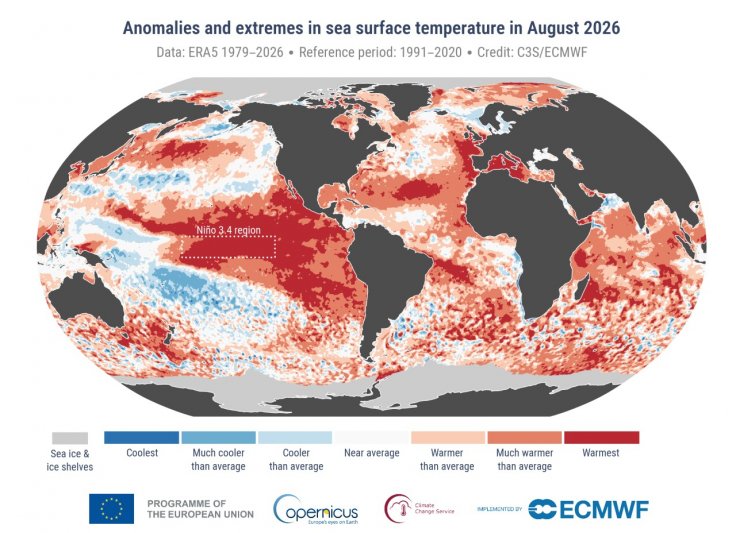
The average sea surface temperature across the extra-polar oceans, between 60°S and 60°N, reached 21.07°C in August, the highest August value in the ERA5 record. It also tied March 2024 for the highest monthly value recorded across all calendar months.
The highest daily global sea surface temperature for the extra-polar ocean reached 21.11°C during the month.
The tropical Pacific was particularly important. Sea temperatures there remained exceptionally high as El Niño conditions strengthened.
El Niño is a natural climate pattern involving changes in ocean temperatures and atmospheric circulation in the tropical Pacific. It can temporarily raise global temperatures because heat stored in the ocean is redistributed through the atmosphere.
Copernicus said the developing event could potentially become one of the strongest El Niño episodes on record.
Its effects were already being seen on land, with conditions supporting the intensification of seasonal wildfires in Indonesia.
climate.copernicus.eu
Western Europe had its hottest summer
Europe also experienced an exceptional season.
Although August was the fourth-warmest August ever recorded over European land, the bigger record came when the entire summer was considered.
Western Europe had its warmest summer on record from June through August 2026, surpassing the previous record set in 2003.
The region experienced repeated heatwaves beginning in May and continuing through August. Large areas of western, central and eastern Europe were also unusually dry.
France, the United Kingdom, Hungary, Romania and Serbia experienced severe drought conditions.
The lack of rain also affected rivers. The Rhine, Danube, Southern Bug and Dnieper recorded exceptionally low flows, while several other European rivers also reached unusually low levels during the summer.
The heat came with other climate extremes
August’s global heat record was part of a wider pattern of unusual climate conditions.
Some regions outside Europe, including parts of the southern United States and northern Mexico, Siberia, Central Asia, China, South America, South Africa and northern Australia, were also drier than average.
Sea ice remained another concern. Arctic sea ice extent ranked 12th lowest for August, while Antarctic sea ice extent ranked fourth lowest for the month.
These individual indicators do not all move in the same direction every year. But taken together, they show how a warmer climate can influence temperatures, rainfall, oceans, drought, wildfire conditions and frozen parts of the planet at the same time.
The August record therefore matters for more than the number 1.65°C. It shows that global warming is not simply about warmer days. The changing climate is interacting with oceans and atmospheric patterns, creating conditions that can intensify heat, drought and other extremes.