Dad, 47, Has ‘Weird’ Moment at Disney—Then Comes Alzheimer’s Diagnosis
“Life definitely didn’t follow the plan I had written for it. Apparently, life didn’t read my plan,” said Jeremy Scott, a 47-year-old mortgage loan originator in Florida whose life was changed forever after an unexpected health diagnosis this month.
“I spent about 25 years in the automotive industry before completely changing careers in my mid-40s,” Scott, who is based in Winter Garden, just outside Orlando, told Newsweek. “I’m a husband, a dad, I work, I go to the gym, I drive. I go to Disney probably way too much, and now I also happen to be navigating Alzheimer’s.”
He decided to share his journey with the disease on his social media channels (@itsjeremyscottofficial on TikTok, Instagram, and Threads).
He began talking about his diagnosis publicly because “when most people hear Alzheimer’s, they picture someone much older and much further along in the disease. That’s not what my life looks like right now,” he said.
A ‘Weird’ Moment at a Disney Resort
Scott was officially diagnosed on September 12, “but looking back, there were things happening before then,” he told Newsweek.
A couple of years ago, he remembers being at Disney’s Contemporary Resort and being unable to find his water bottle. He had searched everywhere all over the resort, from restaurants to shops, before returning to his room to find the bottle was “basically sitting right in front of me.”
“Everyone loses things,” he said. “I lose my keys, you lose your phone, that’s life. But this was one of those moments where I thought, ‘Okay, that was weird.’”
As time went on, he began noticing other things. “I would lose my train of thought, forget what I was doing in the middle of doing it, have trouble finding a word, or struggle to keep up with a conversation,” he said.
The symptoms Scott was experiencing may have been critical signs of his later diagnosis.
Alzheimer’s disease could potentially begin decades before clinical symptoms appear, with its pathology accumulating over 10 to 30 years before the diagnosis, noted a May study in the journal GeroScience.
The study found that blood biomarkers associated with self-reported memory concerns may offer early clues for how the disease may later develop. This association suggests that “AD [Alzheimer’s disease] pathology may begin before age 45 and is associated with subtle changes in cognition that are not at measurable levels,” the study said.
Scott’s official diagnosis “wasn’t completely out of nowhere,” he noted.
“My situation is a little complicated because I had a brain hemorrhage in 2021, was in a coma for six days, and have had other neurological issues since then,” he explained. “So, there were a lot of pieces to this puzzle.”
Around the time just before he received his official diagnosis, he suspected Alzheimer’s disease was a real possibility, after going through cognitive testing, MRIs, blood testing, and other neurological testing.
However, “knowing something might happen and actually hearing it are two completely different things.”
“I remember thinking, I’m 47 years old. I’m not even 48 yet. I have a wife, kids, a career, and plans. How in the world are we talking about Alzheimer’s?” Scott said.
Navigating Alzheimer’s at 47
The symptoms that have the biggest impact on Scott’s daily life at the moment are “probably losing my train of thought and short-term memory.”
He can find himself talking before suddenly thinking, “Where was I going with this?” Or he might start doing something and “forget a step or why I walked into a room,” he said.
He also struggles to find the right words when speaking. “I know exactly what I want to say, but sometimes my brain takes the scenic route getting there,” Scott explained.
Stress is another big factor, he said, and he can “definitely tell that things get worse” when he’s stressed or overwhelmed.
He also recently started speech therapy and cognitive rehabilitation.
“I’m learning ways to slow down, organize things, and work with my brain instead of constantly getting frustrated with it,” he said.
Biggest Misconceptions About Alzheimer’s
The biggest misconception may be that all Alzheimer’s patients exhibit clear symptoms of the disease from the onset.
Scott is often told, “You don’t look like you have Alzheimer’s,” he said, noting, “I hear that constantly,” with people saying, “But you speak fine” or “How are you making videos?”
He said that many assume that once you’re diagnosed, “you immediately can’t drive, work, have a conversation or live independently. That’s simply not where I am right now.”
Noting that Alzheimer’s disease has stages, he said, “People experience it differently, and I am early in this journey.”
The other common misconception is that the disease is exclusively for very elderly people, but “younger people can get Alzheimer’s,” Scott said.
“I think seeing a 47-year-old talking openly about it makes some people uncomfortable because it doesn’t match the picture they have in their head,” he noted. “That’s exactly why I think it’s important to talk about it.”
What’s ‘Completely Changed’
Scott says his diagnosis changed his definition of what is important and “completely changed how I look at time.”
He spent about 25 years in automotive sales management and worked “crazy hours…always chasing the next thing,” be it the next career goal or accomplishment. Then, at 46, he changed careers and became a mortgage loan originator.
Now, Scott sees life very differently. “In a strange way, Alzheimer’s has forced me to become much more present,” he noted.
Scott now desires to do “meaningful work without allowing stress and ambition to consume every hour of my life.” He wants more time with his wife and kids, he wants more experiences, and to write his book, create content, and help people.
“And sometimes I just want to sit at one of my daughter’s school events and realize there is literally nowhere else I need to be. I don’t take those moments for granted anymore,” he noted.
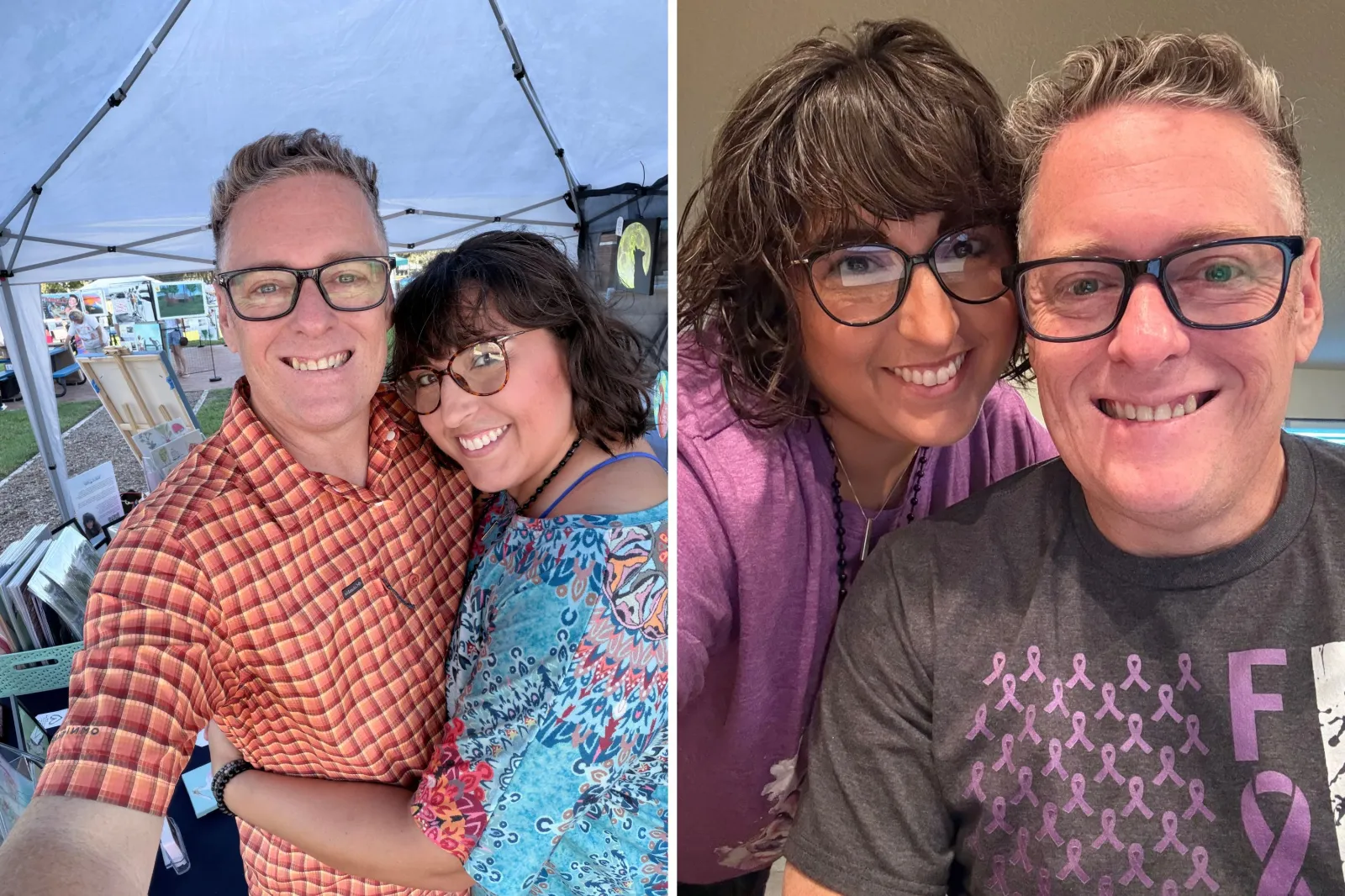
‘I’m Still Living My Life’
Scott said he wants to document his journey with Alzheimer’s disease “as honestly as I can, while I can.” He doesn’t know what the future holds, but “instead of pretending I do, I want to document it. This has probably become the most important part of the journey for me.”
When Scott started sharing more openly about his condition on social media, he was surprised to find an incredible community of others living with Alzheimer’s and dementia, and people who wanted to support him.
“I don’t want everything I see or talk about to be about what I might lose someday,” he said. “I’m still living my life right now. I’m still Jeremy. I’m a husband and a dad. I laugh, I make stupid jokes, I work out, I go to Disney, I have faith, and I still have plans.”
Scott added: “I want people to see the appointments, speech therapy, good days, frustrating days, things I learn, things my family learns, and even the humor that still exists in everyday life.”
And if one day somebody else who is diagnosed young comes across one of his videos at 2 a.m., “scared out of their mind,” and realizes others are going through this too, “then sharing something this personal is worth it,” he said.
Scott is currently figuring out what his next chapter looks like professionally, while also devoting more time to creating content, writing, and advocating around Alzheimer’s disease.
There are still moments when he asks, “Why me?” adding, “I think that’s just human.”
“I don’t want to spend whatever time I have worrying about what I might be like five or 10 years from now. I have today. That has really become my motto through all of this—one step, one day at a time,” he said.
With it still being very early on his journey with the disease, Scott noted: “I certainly don’t have all the answers, but I don’t want Alzheimer’s to be the end of my story. I want it to change the way I tell the rest of it.”
Do you have a health-related story to share? Let us know via life@newsweek.com, and your story could be featured on Newsweek.
Contact Newsweek editors for this story: Sirena Bergman and Anthony Murray.