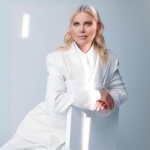
Mira Murati Unveils Her Startup’s A.I. Model in First Interview Since OpenAI
Mira Murati, the former CTO of OpenAI, left the A.I. giant in late 2024 to found her own startup, Thinking Machines Lab, and raised a staggering $2 billion in less than a year. In her first media interview since founding the startup, Murati revealed what she has been building: “interaction models,” or multimodal A.I. systems that process audio, text and video simultaneously and collaborate with humans in near real time, without waiting for prompts. “I have very high conviction that the way to continue building frontier A.I. systems is to [create] systems that are not just autonomously advancing and leaving civilization behind, but are more like a tandem bike,” she said onstage at Bloomberg Tech Summit last week.
“They’re continuously taking in audio, text, video, and continuously providing output,” Murati added, describing the model, called TML-Interaction-Small, which she plans to release publicly later this year.
Unlike many A.I. founders who climbed traditional computer science or venture capital ranks, Murati’s path is rooted in product management. She studied mechanical engineering at Dartmouth College, where she worked on building a hybrid race car. After graduating, she joined Tesla in 2013 as a product manager for the Model X. She later led product and engineering at augmented reality startup Leap Motion (now UltraLeap), focusing on motion-based human-computer interaction.
In 2018, Murati joined OpenAI as head of applied A.I. and partnerships, rising quickly to become chief technology officer. Over six years, she helped steer the deployment of some of the most influential A.I. products, including ChatGPT, DALL-E, and GPT-4.
During Sam Altman’s temporary ousting in November 2023, Murati served as interim CEO for three days, acting as a bridge between Altman and a small group of executives involved in the leadership shakeup. In hindsight, she said OpenAI would have “imploded” without her intervention. “There wasn’t any transition plan, and there wasn’t much thought put into transparency, bringing the team along, providing continuity,” she said. In a recent lawsuit brought by Elon Musk against OpenAI and Altman, Murati also testified that Altman was prone to “creating chaos.”
“The structure of governance in decision-making should not hinge on one person. There should be checks and balances,” she said, reflecting on her time at OpenAI. “To get as many people involved as possible, you have to share the knowledge, you have to share tools, and this is part of the reason why we’ve taken a more open approach with our lab.”
She is now applying those lessons at Thinking Machines Lab, which has attracted top talent from across the industry. CTO Soumith Chintala joined from Meta. Chief scientist John Schulman, an OpenAI co-founder, joined from Anthropic. And Lilian Weng left her role as OpenAI’s vice president to become a founding member.
At the same time, the company has faced talent losses. Meta Superintelligence Labs, led by Scale AI founder Alexandr Wang, has poached five founding members. The most recent, Joshua Gross, now leads engineering teams at Mark Zuckerberg’s lab. Meta reportedly began its aggressive recruiting push after Murati rejected a $1 billion acquisition offer in mid-2025.