

Quad Takes on China’s Mineral Dominance: $20 Billion Plan to Secure Future Tech Supply Chains
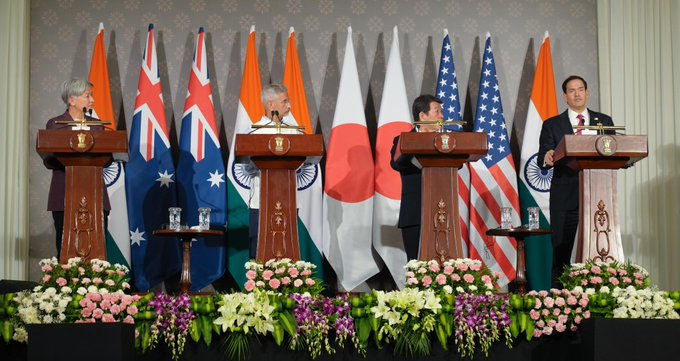
The four-nation Quad grouping has unveiled an ambitious framework to secure critical mineral supply chains, with the US, India, Japan and Australia aiming to reduce dependence on China and strengthen access to materials essential for advanced technologies, batteries, defense systems and artificial intelligence (AI).
Announced during the Quad Foreign Ministers’ Meeting, the initiative signals a major geopolitical and economic shift. For years, China has held a commanding position in the processing of critical minerals, resources vital for semiconductors, electric vehicle batteries, clean energy technologies and military equipment.
Concerns over supply disruptions and market manipulation have pushed governments to search for more resilient and diversified sources.
In a joint statement, the Quad partners said they intend “to support the development of secure critical minerals supply chains, which are essential for advanced technologies, economic growth, and the resilience of our industrial bases”.
Chinese Dominance
The International Energy Agency (IEA) says China remains the dominant player in clean energy technology supply chains, holding the largest manufacturing share in batteries, electric vehicles and renewable energy equipment.
According to its Energy Technology Perspectives 2026 report, China accounts for 60% to 85% of production capacity across multiple supply chain stages and its dominance is unlikely to change significantly before 2030.
The report also highlighted that global industries remain vulnerable to disruptions in Chinese exports. A one-month halt in Chinese battery supply chains could cut electric vehicle production outside China by an estimated $17 billion, while a similar disruption in solar exports could reduce global solar manufacturing output outside China by around $1 billion per month, with Southeast Asia and India among the most affected.
China’s clean energy exports topped $165 billion in 2025, while efficiency, automation, lower energy and labour costs continue to strengthen its manufacturing advantage.
$20 Billion Push to Build Alternative Supply Chains
At the heart of the new framework is a plan to mobilize up to $20 billion in government and private sector support for mining, processing and recycling projects tied to Quad nations, aimed at reshaping the current landscape.
According to the news release, Quad countries will identify projects with a “Quad nexus,” including ventures located in member countries, operated by Quad-based firms, or supplying Quad markets to address key supply chain gaps.
The initiative also outlines financial tools to support strategic mineral projects, including export credit agencies, development finance institutions, loans, guarantees, insurance, subsidies and private capital mobilization.
The move comes amid growing concerns that overreliance on a single country for critical minerals creates vulnerabilities for industries powering modern economies. The framework is designed to build partnerships “with trusted partners, not strategic adversaries,” while creating fairer and more diversified markets.
Regulatory Cooperation and Recycling Focus
Beyond investments, the Quad framework seeks to align regulatory approaches and improve the business environment for mineral development.
The countries said they plan to share best practices on licensing and permitting systems, while exploring ways to streamline approval timelines for projects.
The partners also intend to strengthen tools to review transactions involving critical minerals that could pose national security risks.
Another major pillar of the agreement is recycling and recovery. The Quad nations said they would collaborate to recover critical minerals from electronic waste and scrap materials, reducing dependence on newly mined resources.
It was also said that the countries aim to promote innovation in mineral recycling technologies and improve collection systems. Quad members will also explore cooperation to simplify export and import procedures for waste and scrap materials, in line with domestic laws and international obligations.
The initiative marks one of the clearest attempts yet by the Quad to build a coordinated response to China’s grip on minerals that increasingly underpin economic growth, national security and next-generation technologies.
