Stunning ISS photo of Florida, Cuba captures “moonglint”
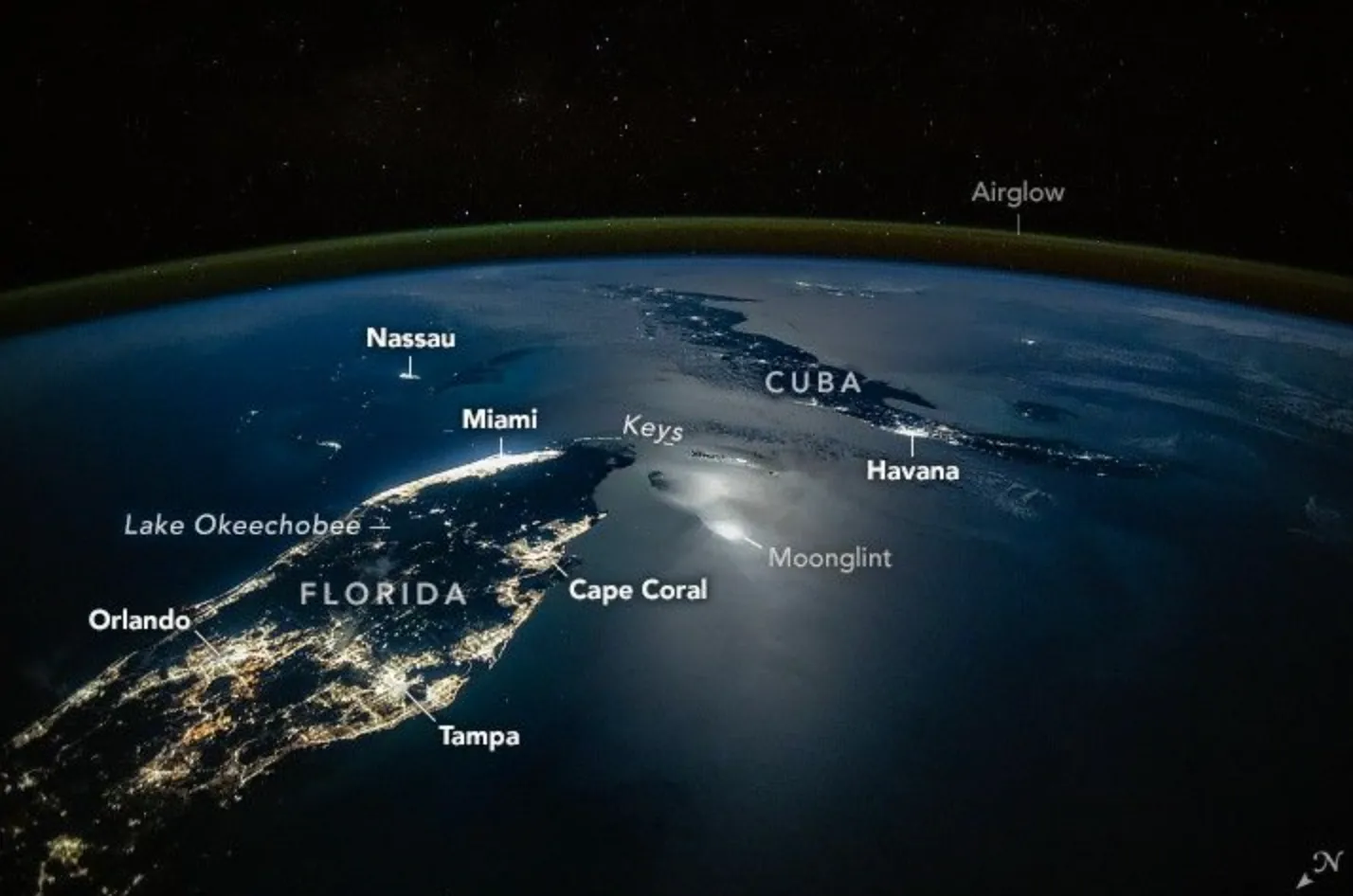
A nighttime picture of Earth taken by an astronaut aboard the International Space Station shows a spectacular “moonglint” between the Florida peninsula and Cuba, a phenomenon that it is impossible to see from the ground below.
The International Space Station, an orbiting laboratory where astronauts from multiple countries can conduct scientific research, is located about 248 miles above Earth.
Why It Matters
Until a few decades ago, we had no photos showing us what our planet looked like from outer space. The first ones were taken in the 1940s from rockets in suborbital flights, meaning the rockets could fly to outer space but could not complete a full orbit around Earth. The most famous, the so-called “Blue Marble” images, followed in 1968.
The quality of the photos we can now take from outer space—whether of our planet or of deep-sky wonders—has significantly improved, allowing us to get a look at phenomena we could not observe before.
What To Know
A “moonglint,” much like a “sunglint,” can often be seen in astronaut photographs. The term combines “moonlight” and “glint” to refer to the shimmering reflection of the moon on a shiny surface, often on water, creating an unusual glow.
In the picture taken by an unnamed astronaut on March 19 and shared by NASA earlier this month, the moonglint can be observed between Florida and Cuba, just to the right of the Florida Keys.
Moonglint, according to NASA, “occurs when the light source (in this case, the Moon) reflects off the water surface at the same viewing angle as the observer—here, a crew member on the space station.”
When the picture was taken, at 2:23 a.m. Eastern time, there were no clouds in the sky, and the moon was in a waning phase, providing about 78 percent of the illumination of a full moon.
If possible, the lights of Miami, to the left bottom of the Florida peninsula in the picture, shine even brighter. Other bright centers at night are Florida’s Orlando, Tampa and Cape Coral and Havana, Cuba.
According to NASA, the urban centers between Miami and Fort Lauderdale form “the brightest stretch of lights along the southeastern Atlantic seaboard.” Offshore from Miami, Nassau, the capital of the Bahamas, is another bright spot.
What Happens Next
The future of the International Space Station, which represents an important center of cooperation among nations, was put at risk by Russia’s invasion of Ukraine in 2022, and it remains uncertain to this day. Space diplomacy will become increasingly relevant in coming years, experts believe, and the station will play a global strategic role.
Those interested in more pictures taken by astronauts aboard the International Space Station can find them here at the NASA/JSC Gateway to Astronaut Photography of Earth.