‘Tip Toe’ Is a Harrowing Melodrama of Queerness and Masculinity in a World Gone Mad
Tip Toe refuses to be misunderstood. Premiering Oct. 2 on Starz, the British miniseries from Queer as Folk creator and Doctor Who reviver Russell T Davies set its stakes as high as the lamppost from which Alan Cumming’s character is seen hanging, dead, just outside his home, in the very first scene. Reminders of this awful outcome open each episode, preceding flashbacks that take us through the escalation of tensions between Cumming’s Leo Struthers and his next-door neighbor, Clive Goss (David Morrissey), over the course of just 10 days. Scripty speechifying and a finale that strains believability notwithstanding, Tip Toe is, in its unabashed melodrama, a harrowing cri de coeur about masculinity in crisis and queer liberation reversed.
Leo and Clive have a few things in common. Both pushing 60, the men have been sharing a wall in outwardly identical Manchester rowhouses for 14 years. They’ve also both, when we meet them, hit rough patches in life. Clive, an electrician, is having trouble finding enough work to support a family that includes touchy 16-year-old George (Jackson Connor) and 25-year-old Saul (Joseph Evans), who assists his dad on jobs but isn’t exactly earning the kind of money that would enable him to move out. As gossip swirls that he’s cheated on her, Clive’s wife, Marie (Pooky Quesnel), constantly berates him. Meanwhile, Leo’s longtime partner, Curtis (Charlie Condou), has left him for a woman. Not only is he unmoored in his personal life, overrelying on his indulgent best friend, Stephanie (Elizabeth Berrington); he’s also struggling to manage Spit & Polish, the bar in Manchester’s gay nightlife district that he and Curtis used to run together.
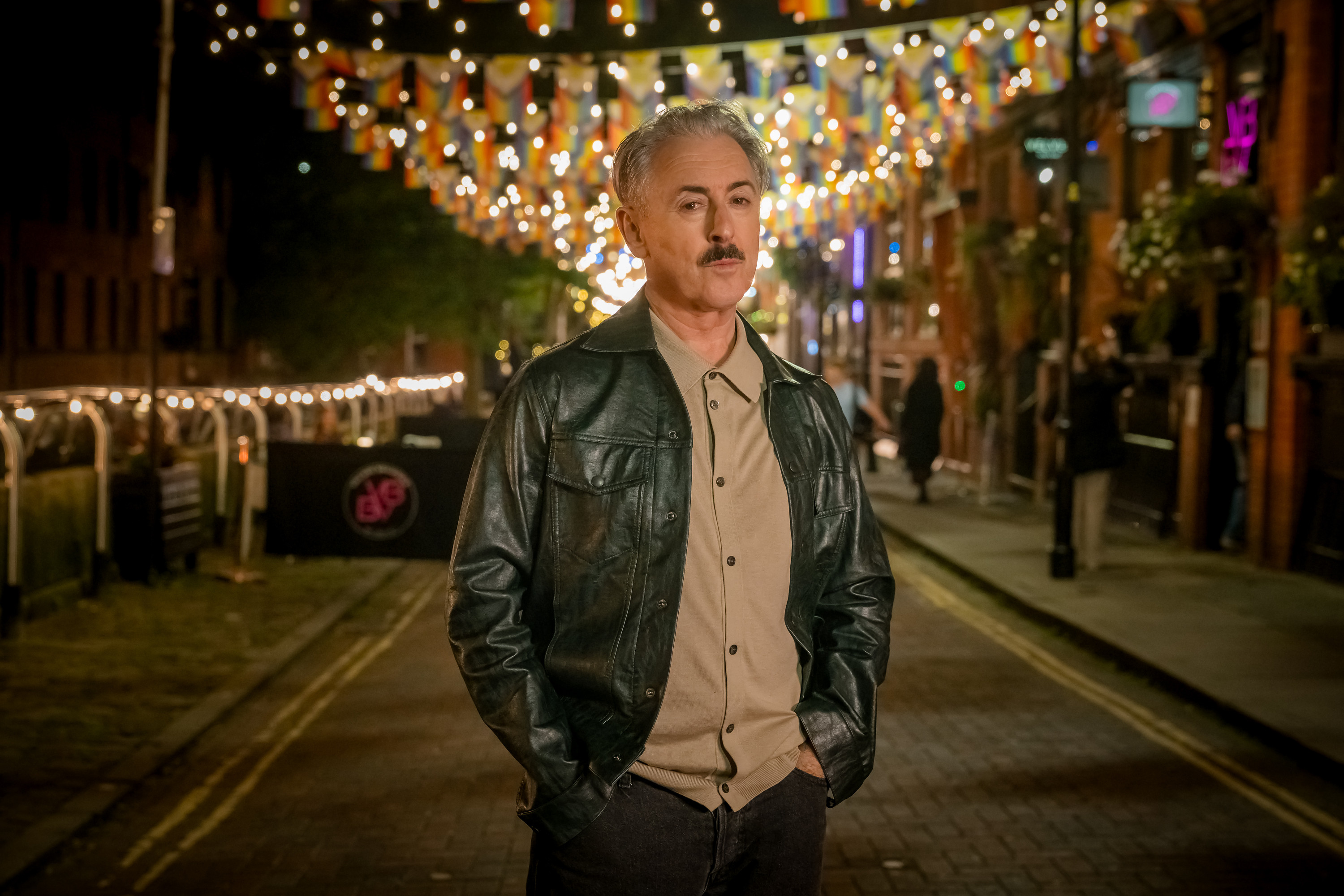
Early one morning, Leo chases after an anonymous hookup who has just absconded with his laptop—only to find himself locked out of his house in his underwear. Clive reluctantly lets him in to call Stephanie for a spare key, making clear all the while that Leo’s lifestyle disgusts him and that he’s uncomfortable having his neighbor around his sons, one underage and the other a musclebound Adonis. The thing is, Clive’s kids are nowhere near as innocent as he thinks. And he’s drawn further out of his comfort zone when Leo, against his better judgment, hires Clive and Saul to fix some wiring at Spit & Polish. The first sign of worlds perilously colliding is when a bar employee recognizes Saul from OnlyFans. An unsubtle but rhetorically effective montage of Leo and the Gosses, each in separate rooms, indulging in their preferred forms of pornography, reveals both the secrets they’re keeping from each other and the loneliness they share.
While Tip Toe spends time with all of these characters, Leo is its protagonist. And he’s an admirably imperfect one, charming and fundamentally kind but also pugnacious, prone to exaggeration, self-centered enough to earn Stephanie’s accusation that he doesn’t really value women. (She, in turn, shows glimpses of the J.K. Rowling-style transphobia that seems to afflict British feminists more than most.) His bar functions as a portal into the lives of less privileged members of the queer and trans communities, from his old, flamboyant, gender-nonconforming friend and unrequited admirer, Melba (Paul Rhys), to a 20-something trans bartender (Iz Hesketh), who’s calling herself Zee as she deliberates on a permanent female name—and who dodges transphobic violence daily. The question of whether the visibility Leo’s generation fought so hard to win has backfired, making them all easy targets, haunts the series.

Davies recently raged against the homophobia of the early AIDS crisis in the searing period piece It’s a Sin and looked queasily ahead to a dystopian future in the sci-fi family drama Years & Years. Tip Toe unites their themes to complete a sort of trilogy, combining the anxieties of LGBTQ people, intrafamilial alienation, economic strife, the social-media panopticon, and an overarching sense of doom into a fire sermon against our toxic present. That it shares its Manchester setting with the far breezier, Y2K-era Queer as Folk underlines just how much that community’s outlook has changed in a quarter-century. And the fact that Cumming’s phenomenal performance is airing concurrently in the U.S. with The Traitors: New Blood, which he hosts with high-camp aplomb and an androgynous glam wardrobe, highlights the cognitive dissonance of a society where queerness is embraced—by everyone except the sizable faction that actively hates it. More than just Leo’s antagonist, Clive is an avatar for straight masculinity in crisis, desperately vulnerable but too terrified of showing emotion to say so. Morrissey captures that tightness of that bind. Devalued at home and work, he dabbles in conspiracy theories and marinates in videos of “real deaths.” His story can feel like an adult Adolescence.
Tip Toe also calls to mind other recent series (BEEF, too many reality shows about feuding neighbors) and films (Eddington, Three Billboards Outside Ebbing, Missouri) that translate current political and social fault lines into tête-à-tête conflicts. On both sides of the Atlantic, storytellers are trying to understand the hateful tenor of the contemporary public sphere by distilling it down to its simplest, me-against-you form. The difference here is that, although Leo and other characters are shown to have healthy senses of humor, Tip Toe itself doesn’t share those titles’ tone of black-comic absurdity. It isn’t a funny show. Sometimes its seriousness veers into stridency. I didn’t find the abrupt escalation to Leo’s death particularly convincing.
Yet, as in It’s a Sin and Years & Years, it’s the incandescent clarity of Davies’ anger and fear that make Tip Toe powerful. For all the dumbed-down dialogue we get from streamers worried they’ll lose distracted viewers unless someone on screen recaps the plot every five minutes, it’s rare to hear characters plainly state things like: “History tells us one thing—that blood and fire and retribution always happen. And right now it’s coming for us.” When Stephanie confesses her worry that she’ll die in 30 years without living to see the pendulum of progress swing society out of what she calls a “new Dark Age,” I suspect she’s speaking for a lot of people. Too often in fiction (which this is, despite ending title cards that purport to update us on the characters’ lives post-Leo), social commentary is inoculated with optimism or couched in irony. In its unblinking earnestness, Tip Toe’s melodrama accesses a truth that transcends any shortcomings of its plot.