Trump gives Middle East its own NATO moment
War in the Middle East escalated again this week after Saudi Arabia crossed the line separating diplomacy from conflict, joining the U.S. in striking Iranian-linked targets in Iraq.
Riyadh’s military intervention, which brought a swift and violent end to what had been a brief reprieve in the fighting, came amid reports the Kingdom also wants to assemble an international coalition aimed at defending the Red Sea from Yemen’s Houthi forces, who earlier this month announced a naval blockade of the vital trade route bridging Europe, Asia, and Africa.
All this, just days after Kuwait followed Saudi Arabia’s lead and struck a defense pact with nuclear-armed Pakistan, suggests that we may be witnessing a new dawn for regional security.
By joining Israel’s war on Iran, President Donald Trump has simultaneously emboldened Tehran and Yemen’s Houthis and made it painfully clear to regional allies that relying on America alone for their security is simply not good enough.
A long-term shift toward a collective defense approach in the Middle East led by Gulf states could help stabilize the region—but Washington will need to give up some influence to make it happen.
Safe Havens No More
For the past quarter century, as Islamic extremism swept across the Middle East and the West waged its wars in Iraq and Afghanistan, the Gulf states were carefully curating their status as political and commercial “safe havens.”
The likes of Saudi Arabia, the UAE and Qatar transformed themselves into world-renowned trade hubs, oil exporters and low-tax destinations for white-collar Westerners to make their fortunes. This global web of political and commercial relationships afforded the Gulf states outsized influence, which they used to position themselves as vital intermediaries in global disputes.
The India-Pakistan conflict, Russia-Ukraine prisoner swaps, ceasefires in Gaza and even the agreement for the U.S. to pull out of Afghanistan were achieved in no small part due to the involvement of Gulf negotiators, whose economies appeared insulated from the instability plaguing the rest of the region.
A few Iranian drones shattered this façade of security, and now, Saudi Arabia has decided it needs to do more than talk. Yes, the Kingdom has joined its chief security partner America in hitting back at Iranian assets, but the Saudis are already signaling a desire to pursue bigger plans.
Since the moment he entered office a second time, Trump has bullied European countries to take responsibility for their own security, contribute more to NATO and reduce their dependence on American military power. War in Iran appears to have given the Gulf states similar ideas.
The Middle East is by no means forming a literal equivalent: there are no plans for an Article 5-style Gulf-wide treaty, no integrated command structure and no shared political identity comparable to the transatlantic alliance.
But the reported Saudi proposal for a defense coalition to protect the Red Sea is indicative of a NATO-style approach to regional security; one that seeks to solicit the will of countries worldwide to unite their military prowess for mutual benefit. Even when, like in the case of the Red Sea, the flashpoint may be thousands of miles away from the borders of some contributors.
Sharing the Burden Far and Wide
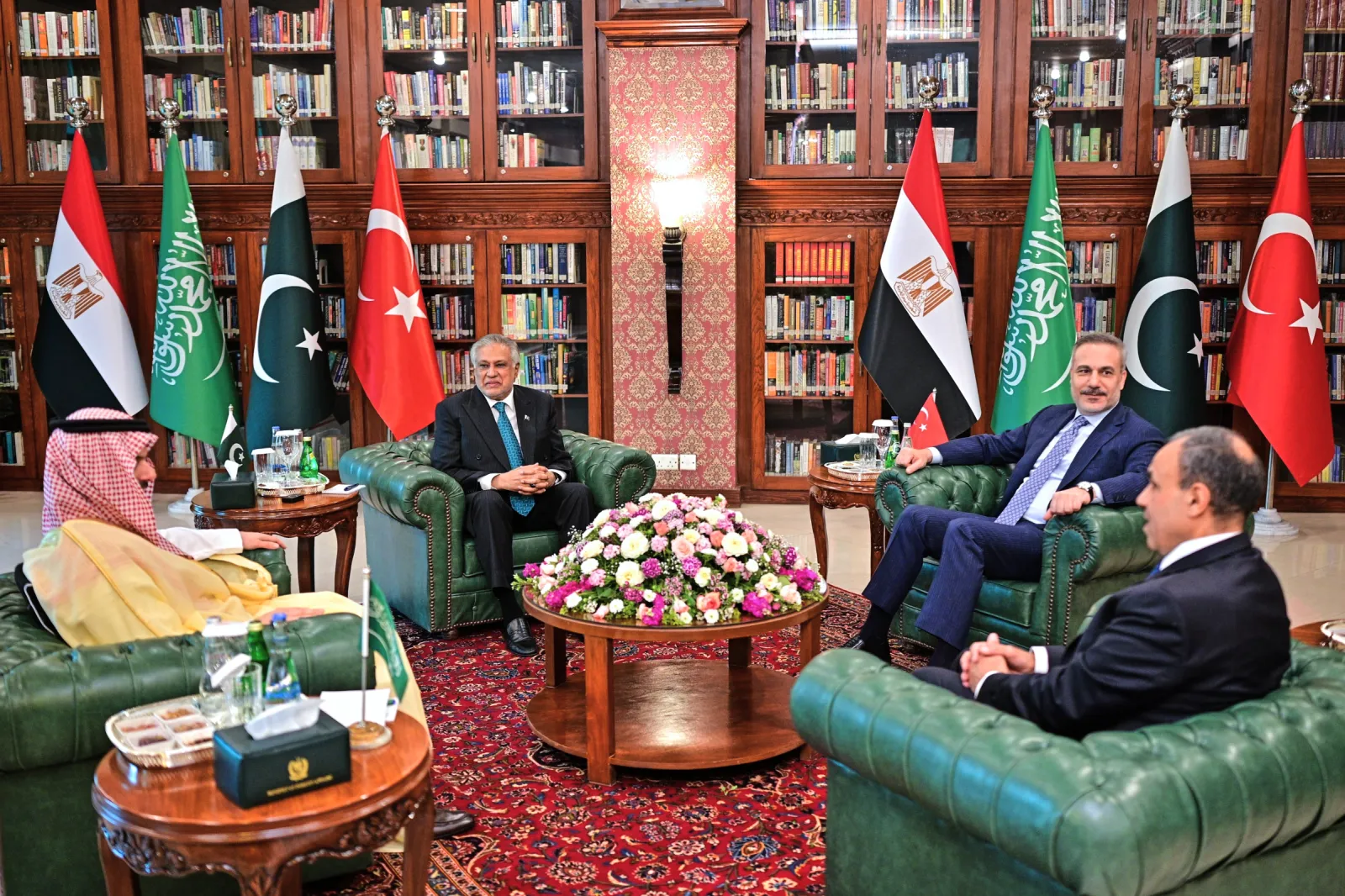
For Saudi Arabia, this is simply a logical next step down the road of diversifying insurance providers. In September 2025, the Kingdom signed a Strategic Mutual Defense Agreement with Pakistan, which says aggression against either country will be treated as aggression against both.
It also served as an example to the other five members of the Gulf Cooperation Council, one of which—Kuwait—finally ratified a security pact with Islamabad this week after three years of talks.
These moves may foreshadow a broader pattern whereby Gulf states apply their global attitude to the commercial realm into the security realm. They’ll still work with the U.S., but the Pentagon will no longer be the only security guard on the block.
The emergence of such a scenario could also serve U.S. interests. If the Gulf states display a willingness to take military action in their backyards and work more closely with international partners to defend their interests, it would reduce the burden on American forces in the Middle East.
It would also create a litany of new challenges.
Greater Autonomy, but What About Alignment?
First, Iraq has already sharply condemned U.S.-Saudi strikes on its territory as violations of sovereignty. More militia retaliation could see another Middle Eastern nation dragged into the fighting, further complicating what is already a complex conflict.
Second, any security coalition that Saudi Arabia manages to pull together will have to gauge its willingness to be implicated in said conflict.
Using its stockpiles of missiles and drones, Iran has demonstrated its ability to cause a serious headache for the titanic U.S. military and Israel, despite being outmatched across almost every conceivable metric on paper. Yemen’s Houthis will employ a similarly asymmetrical approach to attacking the Red Sea and the Bab el-Mandeb Strait.
And third, a Gulf security order built upon an overlapping network of defense pacts and coalition-building coalitions may be more resilient than the old model, but it will also be harder for Washington to steer.
If this prospect unfolds, Trump’s Iran campaign will be remembered for more than the chaos it unleashed. A more stable Middle East better equipped to police its own future crises would be welcomed by just about everyone—except those in Washington who want to preserve America’s power to set the rules.