

Two New Sea Spider Species Found in Salish Sea After Nearly a Century
Two previously unknown sea spider species have been discovered in Canada’s Salish Sea, marking the first description of new sea spider species from the region in almost a century. University of British Columbia (UBC) researchers found the animals during scuba dives between September 2023 and August 2024, at depths of up to 18 meters (59 feet).
The discovery, published in the peer-reviewed journal Organisms Diversity & Evolution, gives scientists new information about a poorly documented group of marine animals. Researchers also used DNA analysis and detailed imaging to confirm the species and build a guide for identifying sea spiders in the region.
Two unusual species found underwater
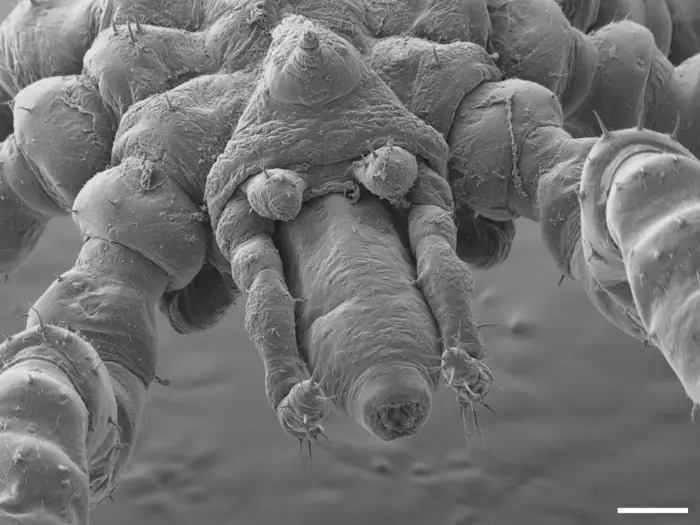
One of the newly identified species is Callipallene pilosuspedes, a small sea spider named for the long, curved spines covering its lower legs. The name combines the Latin words for “hairy” and “feet.”
The animal has red eyes, a short proboscis used to handle food, claws, and a triangular mouth with three lips. Researchers also found that its ovigers, special appendages used by male sea spiders to carry eggs, can double as grooming tools.
Under a microscope, the researchers observed the animal wrapping these appendages around its legs and using comb-like spines to clean itself.
The second species, Tanystylum kiixin, was named after an ancient Indigenous village site near where it was first collected. The name is pronounced “kee-hin” and comes from the sound of waves crashing at the base of the site.
Cormac Toler-Scott
Unlike Callipallene pilosuspedes, Tanystylum kiixin has smaller and less flexible egg-carrying limbs. That appears to make grooming more difficult, and researchers frequently found tiny parasites living on its body.
Toler-Scott described the situation as “an ecosystem within an ecosystem within an ecosystem.”
Why finding them matters
The discovery is important because scientists have had limited information about the sea spiders living in the Salish Sea, despite the area’s rich marine life.
Only 17 sea spider species had previously been reliably documented in the Salish Sea, according to the study. The new research adds two more species while also providing genetic information for several sea spiders that had never previously been sequenced.
Lead author Cormac Toler-Scott conducted the research during his master’s degree in zoology at UBC. He became interested in the animals while looking for information about how sea spiders might be affected by climate change and human activity.
“I was interested in how sea spiders are impacted by climate change and human disturbance, because marine invertebrates in the Salish Sea are particularly at-risk, and I couldn’t find anything,” Toler-Scott said in the UBC statement.
Cormac Toler-Scott
He said the lack of information is partly because scientists do not yet know enough about which species live in the area or how they live.
What makes sea spiders different
Despite their name, sea spiders are not true spiders. They are marine arthropods related to spiders, scorpions and horseshoe crabs.
They evolved around 500 million years ago and have remained in the ocean. Most shallow-water species are very small, while some Antarctic species can grow to more than 70 centimeters (28 inches).
Sea spiders have long legs and a proboscis that they use to take fluids from soft-bodied prey. Their digestive and reproductive systems extend into their legs, giving them a body structure very different from that of familiar land spiders.
Their reproduction is also unusual. Female sea spiders produce eggs, while males collect the eggs with specialized limbs called ovigers and carry them until they hatch.
More species may still be waiting
The researchers collected the newly identified animals from several locations, including Quadra Island, Vancouver, Bamfield and Victoria. Their work covered different marine habitats and depths, showing that more surveying could reveal additional species.
Toler-Scott said the discovery is probably not the end of the story.
“I only had one field season, but there’s definitely more diversity out there that we haven’t documented,” he said.
That possibility is particularly relevant as the Salish Sea faces increasing human activity. The researchers said documenting the animals that live there is an important step toward understanding the region’s biodiversity and identifying where conservation efforts could have the greatest impact.
