

US Blacklists Chinese Satellite Firms Over Iran-Linked Military Imagery Claims
The US has widened sanctions against Chinese and Hong Kong-based entities accused of supporting Iran’s military procurement network.
The US government has targeted three satellite firms allegedly linked to Iranian military operations as well as companies suspected of helping Tehran secure weapons and missile-related materials.
Chinese Satellite Firms Accused of Aiding Iranian Operations
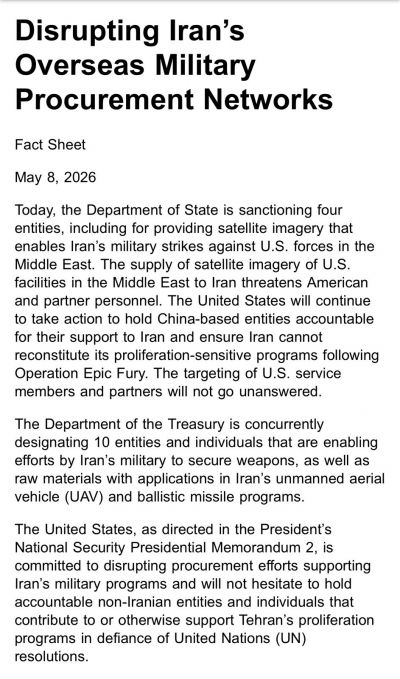
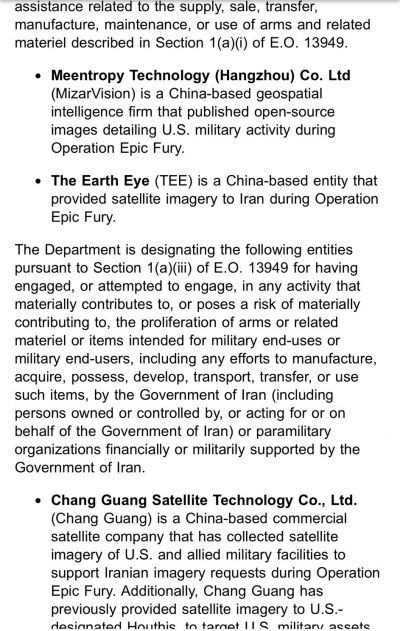
In a fact sheet, the US State Department announced sanctions against three Chinese satellite firms, Meentropy Technology (Hangzhou) Co. Ltd (MizarVision), The Earth Eye (TEE) and Chang Guang Satellite Technology Co., Ltd., accusing them of supplying imagery that aided Iran’s military activities against American forces in the Middle East.
“Today, the Department of State is sanctioning four entities, including for providing satellite imagery that enables Iran’s military strikes against US forces in the Middle East,” the State Department said adding, “The supply of satellite imagery of US facilities in the Middle East to Iran threatens American and partner personnel.”
According to the State Department fact sheet, MizarVision, a Hangzhou-based geospatial intelligence firm, “published open-source images detailing US military activity during Operation Epic Fury,” while Beijing-based The Earth Eye allegedly “provided satellite imagery to Iran during Operation Epic Fury”.
Chang Guang Satellite Technology, China‘s first commercial satellite company, was accused of collecting imagery of US and allied military facilities to support Iranian requests during the operation.
The measures form part of a broader sanctions package unveiled jointly by the State and Treasury departments targeting more than a dozen entities and individuals across Iran, China, Belarus and the United Arab Emirates, accused of enabling Iran’s military procurement activities.
1 of 2
X
X
X
Broader Sanctions Target Weapons and Missile Supply Chains
Additionally, according to the South China Morning Post, the Treasury Department said those sanctioned were “enabling efforts by Iran’s military to secure weapons” and obtaining “raw materials with applications in Iran’s Shahed-series unmanned aerial vehicles and ballistic missile programme”.
Among those targeted are mainland China-based Yushita Shanghai International Trade Company, accused of helping Tehran procure arms and Hitex Insulation Ningbo Company, alleged to have supplied millions of dollars’ worth of materials linked to ballistic missile research and flight test launches. Hitex legal representative Li Genping was also sanctioned.
Hong Kong-based HK Hesin Industry Company was accused of acting as an intermediary in procurement efforts, while Mustad Limited allegedly helped Iran’s Islamic Revolutionary Guard Corps (IRGC) acquire weapons. AE International, another Hong Kong-registered entity, was also included in the sanctions package.
The State Department said the Ministry of Defence Export Center, the overseas sales arm of Iran’s defense ministry, was also designated.
“The US will continue to take action to hold China-based entities accountable for their support to Iran and ensure Iran cannot reconstitute its proliferation-sensitive programs following Operation Epic Fury,” the State Department fact sheet stated. “The targeting of US service members and partners will not go unanswered.”
Sanctions Add Friction Ahead of Trump’s China Visit
The sanctions arrive days before President Donald Trump’s planned 14-15 May visit to China, potentially adding strain to already tense bilateral ties.
According to reporting by the South China Morning Post, senior Trump administration officials, including Treasury Secretary Scott Bessent and Secretary of State Marco Rubio, have urged Beijing to use its influence over Tehran to support ceasefire efforts.
Responding to the sanctions, the Hong Kong government told the South China Morning Post it enforces only United Nations Security Council sanctions and “do[es] not implement unilateral sanctions imposed by other countries”.
