

Utah’s Rocky Mountains Hide a Massive Ice Reserve That Could Hold Nearly 1 Billion Tons of Water
A rocky slope beneath Utah’s Mount Timpanogos is hiding a huge body of ice that contains about 1.55 million cubic meters of frozen water, enough to fill roughly 600 Olympic-sized swimming pools, according to a University of Utah study published Aug. 26, 2026, in the Journal of Geophysical Research.
The finding follows earlier research published April 2 in Geophysical Research Letters that examined how the unusual ice-filled formation gains new mass, offering a clearer picture of how Utah’s hidden mountain water stores form and survive.
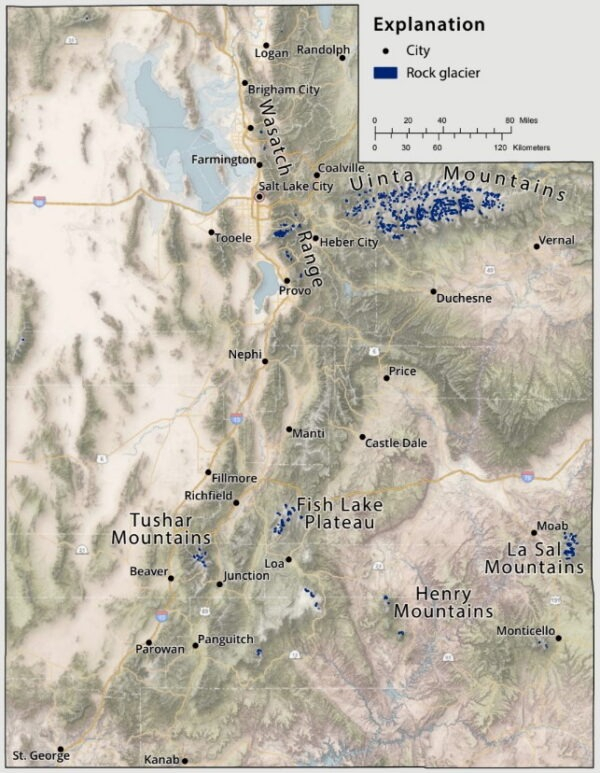
The discovery matters because the ice is not sitting in a typical glacier that can be easily seen from the surface. Instead, it is buried beneath layers of loose rock, making the formation look more like a massive pile of rubble than a frozen reservoir. The researchers say Utah’s 836 known rock glaciers could collectively contain about 0.99 gigatons of water, or roughly 815,000 acre-feet.
The glacier that does not look like a glacier
The formation studied by the researchers is the Timpanogos Rock Glacier, located in a cirque beneath Mount Timpanogos near Salt Lake City and Provo.
Rock glaciers are different from conventional glaciers. Their ice is covered by loose stones and debris, sometimes several meters thick. That rocky covering can insulate the ice from heat and slow melting, allowing these formations to persist in mountain environments where exposed glaciers may not survive.
At Timpanogos, the hidden ice-rich section reaches about 30 to 45 meters (100 to 150 feet) thick in places. The researchers’ models found an average thickness of 18.8 meters and an ice fraction of 83% within the ice core.
Bronson Cvijanovich/The University of UTAH
That means a landscape that appears to be mostly rock is actually dominated by ice beneath the surface.
“Timpanogos Rock Glacier is surprisingly ice-rich. It is 83% ice and 17% loose rock,” Bronson Cvijanovich, lead author of the Journal of Geophysical Research study, said in the University of Utah’s research announcement.
Scientists used gravity to see underground
The biggest challenge was figuring out how much ice was hidden beneath the rocks without digging into the formation.
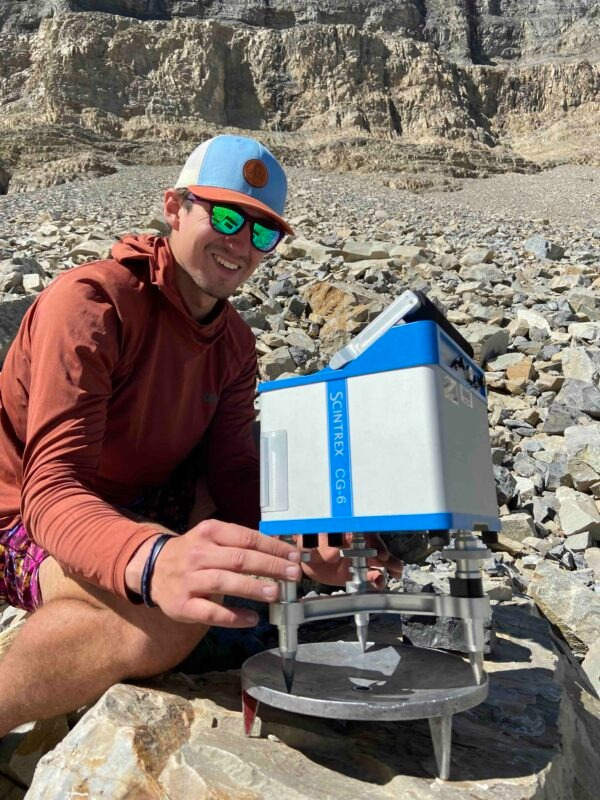
During fieldwork in fall 2024, Cvijanovich and his colleagues took 232 gravity measurements across the rock glacier. The measurements were spaced about 25 meters apart.
The technique works because rock and ice have different densities. Rock is heavier, while ice is less dense. That difference produces tiny variations in the local gravitational field.
“There is a large contrast in mass density between the rock that makes up Mount Timpanogos and the much lower density ice that is in the rock glacier adjacent to it,” geophysics professor Michael Thorne explained. He said areas with thicker ice showed a larger decrease in measured gravitational acceleration.
The team then corrected the measurements for factors including elevation, terrain, latitude, and the gravitational effects of the Sun and Moon. They used 3D Bayesian inversion, a statistical modeling technique, to reconstruct the shape of the buried ice.
The result was a three-dimensional picture of the hidden ice body rather than simply a few depth measurements.
Why the ice is there in the first place
The second study helps answer a different question: How does a glacier form underneath a mountain of rocks?
The researchers found that rockfalls can bury persistent snow, particularly in steep mountain cirques. As the surrounding mountains erode, falling debris covers snow that survives from season to season.
In years with heavy snowfall, cooler summers and larger rockfalls, more ice can be added to the rock glacier.
This means these formations are not simply frozen leftovers from the last Ice Age. The researchers found that rock glaciers such as Timpanogos developed during the thousands of years after the major Ice Age glaciers retreated.
And unlike an ancient ice body that is only slowly disappearing, Timpanogos Rock Glacier is still gaining ice today, according to the University of Utah researchers.
“There’s a lot of ice that’s hidden in Utah’s mountains,” glaciologist Leif Anderson said. “When we are high in the mountains and walking across loose rocks or rubble, you don’t realize there could be 120 feet of ice buried beneath your feet.”
Utah Geological Survey
A much bigger water story
The researchers used the Timpanogos measurements to develop a mathematical relationship between a rock glacier’s surface area and the amount of ice beneath it.
Applying that relationship to other formations produced a much larger estimate of the water hidden in rock glaciers.
The study estimates that intact rock glaciers worldwide hold the equivalent of about 48.03 gigatons of water. In the western United States, the estimate is about 11.92 gigatons, while Utah’s total is about 0.99 gigatons.
A gigaton is one billion metric tons of water.
The researchers also estimate that the Wasatch Mountain Range alone contains about 0.08 gigatons of water in rock glaciers.
These numbers are estimates rather than direct measurements of every rock glacier. The researchers emphasize that more formations need to be studied with geophysical methods to improve the estimates. Their area-to-volume relationship also depends on assumptions about the shape of rock glaciers.
Why hidden ice could matter as the climate warms
The discovery could become increasingly important in places where conventional glaciers are shrinking.
Rock glaciers can survive in warmer and drier environments because their rocky surface helps shield the ice underneath. That makes them potentially important long-term stores of frozen water, particularly in regions such as Utah where water resources are already under pressure.
Bronson Cvijanovich/The University of UTAH
But the researchers also point out that rock glaciers are not automatically permanent reservoirs. Their contribution to downstream water supplies remains difficult to determine because scientists do not yet know how much ice melts from many of them each year.
They can also become unstable. Changes in their internal ice and debris structure can contribute to movement, rockfalls, and debris flows, creating hazards for areas farther downhill.
For Cvijanovich, the importance goes beyond the surprising amount of ice beneath one mountain.
“Rock glaciers flow downhill just like a glacier or river, but the important distinction here is that the thick carapace of loose rock actually protects and hides the ice, making these climate-resilient water storage sites that may still be adding frozen water,” he said. “From a water resource standpoint, it is really important, especially in a warm and arid state like Utah.”
The new research therefore changes what scientists can see beneath seemingly ordinary fields of mountain rubble: what looks like rock may actually conceal a substantial reserve of frozen water.
