

Venus Has Passed Peak Brilliance: What Skywatchers Can Still See This Week
Venus reached its greatest brilliancy on Friday, September 18, 2026, shining at magnitude -4.8, but the planet remains a striking sight in the evening sky on September 19 and over the next several days. Skywatchers should look low toward the western horizon shortly after sunset, where Venus will appear as an exceptionally bright point of light before setting soon after the Sun.
The September 18 peak was the brightest point in Venus’ current evening appearance, but it does not mean the planet suddenly disappears afterward.
Venus will continue to be visible during the coming days, while other planets and celestial events take over the skywatching calendar. The September equinox arrives September 22, Neptune reaches opposition on September 25, and Mercury passes close to Spica that same day.
Venus is still bright enough to spot easily
On September 18, Venus reached magnitude -4.8, making it dramatically brighter than ordinary stars. Although its greatest brilliancy has now passed, the planet remains an easy naked-eye target.
The key is to look in the right place.
Venus is currently in far southeastern Virgo and sits low in the southwestern sky after sunset. On September 18, Astronomy reported that it stood about 7 degrees above the horizon 20 minutes after sunset and set roughly 70 minutes after the Sun.
That means skywatchers on September 19 should not wait until late evening. Venus is a short-lived evening target, so a clear view toward the western or southwestern horizon is more useful than a dark sky several hours after sunset.
NASA/JPL-Caltech
Buildings, trees, and mountains can easily block it because of its low position.
Why does Venus become so bright?
Venus can become extremely bright because of its position between Earth and the Sun.
Unlike stars, Venus does not produce its own light. It reflects sunlight. As Venus moves around the Sun, the amount of its illuminated surface visible from Earth changes.
At greatest brilliancy, Venus is close enough to Earth to appear large while still showing enough of its sunlit side to reflect a tremendous amount of light toward us.
According to Astronomy, Venus reaches greatest brilliancy at two points in its orbit when it is about 39 degrees from the Sun as seen from Earth.
The planet’s brightness also explains why Venus can look like a star even though it is a planet.
A telescope reveals a different Venus
There is another reason this week’s Venus is interesting.
To the naked eye, Venus looks like an intensely bright white point. Through a telescope, however, it appears as a crescent.
Around the September 18 peak, only about 25% of Venus’ disk was illuminated, while its apparent diameter was roughly 39 arcseconds.
This is a reminder that Venus’ brightness is not simply about how much sunlight is falling on the planet. Its changing phase and apparent size from Earth’s perspective both affect how bright it appears.
NASA/JPL-Caltech
For telescope observers, twilight can be a useful time to view the planet, but the Sun must be completely below the local horizon before a telescope is pointed toward the sky.
September 22 brings the autumn equinox
Venus is only one part of a changing September sky.
On September 22 at 8:05 p.m. EDT, the autumnal equinox will mark the astronomical beginning of fall in the Northern Hemisphere. At that moment, the Sun crosses the celestial equator from north to south.
Day and night are roughly equal around the equinox, but they are not exactly the same length. The Sun’s apparent size and Earth’s atmosphere both contribute several extra minutes of daylight.
For the Southern Hemisphere, the same event marks the beginning of astronomical spring.
Neptune and Saturn set up another skywatching target
By September 24, attention shifts toward the outer Solar System.
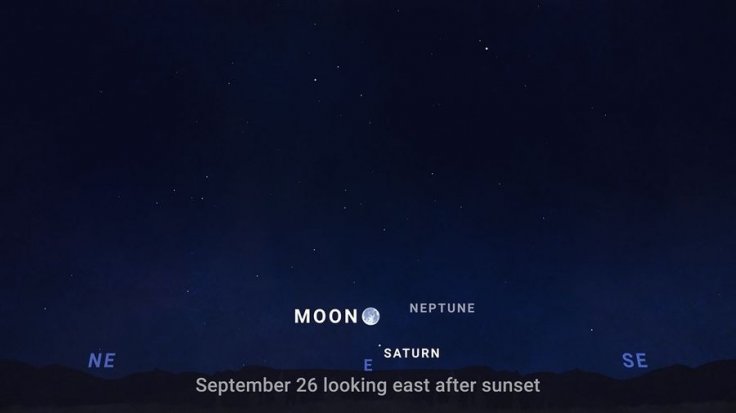
Neptune will sit close to the background star HIP 968, creating a contrasting blue-and-yellowish pairing. Neptune will appear bluish-gray, while the star should look yellowish.
The two objects will be separated by only about 1.5 arcminutes, but Neptune is too faint to see without optical equipment. Binoculars or a telescope will be needed to find it.
Saturn will also be visible nearby in the sky, giving observers another bright planet to locate before attempting to find Neptune.
Mercury meets Spica on September 25
The week ends with another short viewing opportunity.
On September 25, Mercury will pass within 1 degree of Spica, the bright star in Virgo. The pair will appear very low in the western sky shortly after sunset and will set about 40 minutes after the Sun.
Mercury will shine at magnitude -0.2, while Spica will be around magnitude 1.0. Venus will remain nearby and will be considerably brighter, at magnitude -4.8.
So, while Venus’ peak brilliance is already behind us as of September 19, the planet remains the easiest target in this week’s evening sky. The bigger attraction now is the sequence that follows: Venus after sunset, the equinox on September 22, Neptune’s close pairing on September 24, and Mercury’s meeting with Spica on September 25.
