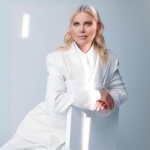
Wallace Chan’s Dual-Site Exhibition Bridges Not Only Geography But Also Matter, Energy, Past and Future
Cultures and religions across latitudes have developed their own cosmologies, but most share some notion of worlds within worlds, mazes and labyrinths that articulate the vital entanglement between microcosm and macrocosm, between the celestial and the terrestrial. His career as a jeweler and craftsman contributed to Wallace Chan’s deep knowledge of geological time and his attunement to the cosmic dimension—an awareness that finds full expression in his art. Working with crystals and gems, Chan creates his own mythology of time, cyclical transformation and the perpetual possibility of renewal.
A monumental two-chapter exhibition by the Chinese artist is unfolding this season across two cities historically connected by
In Chan’s practice, the distance between jewelry, sculpture, engineering and metaphysics collapses. After launching his career as a gemstone carver, he has since spent more than 50 years developing a material language in which jewelry is not ornament but sculpture at the scale of the body, while sculpture becomes, in his words, a jewel for space.
During the busy opening week of the Venice Biennale, Observer engaged in a deep conversation with the Chinese master at “Vessels of Other Worlds,” his show in the chapel of Santa Maria della Pietà, facing the Grand Canal. As we spoke, time and space seemed suspended inside the energetic capsule he had created, which reactivated and expanded the potential of that sacred space.

Inside the chapel, three stratified titanium vessels inspired by the three sacred oils, the Olea Sancta, are surrounded by a constellation of suspended titanium sculptures suggesting oil drops in motion and representing the flow of matter and energy. Around them, human and other biological entities multiply, suggesting connection and vital interrelation within the cycle of life and evolution. Gemstones, insects, vessels, faces,
Chan agrees they are vessels, but also calls them tools, which operate both functionally and metaphorically. They are devices that, like any religious tool, can help one reach something—but also spiritual and energetic vehicles that carry the viewer toward the realms most central to his practice: material, light, sound and

Taken together, the works in the exhibition are intended to symbolize the three stages of life—birth, growth and rebirth—while drawing further inspiration from the mysticism of Hieronymus Bosch’s The Garden of Earthly Delights. “We are here on earth, and we have our experiences, enlightenment and wisdom. Are we going to bring that with us, in our DNA, into a new life? How are we passing it on? All of this is related to that very simple cycle,” Chan explains, pointing out how each sculpture gathers signs associated with birth, growth and rebirth into a personal symbolic system. Because birth is a universal experience no one remembers directly, Chan imagines it as an immediate encounter between the body and the world, in which the newborn begins forming itself through contact with its surroundings. “Birth is a very unique experience. We have all experienced birth, but none of us remembers what it was like. These sculptures are attempts to describe and evoke that moment: when the baby comes out of the mother’s body, the baby immediately begins making connections with its surroundings, trying to be informed by the world and using that information to form itself. It is about interaction with the world.”

“That is why the vessels are so complex: they want to emphasize the constant reflections, interactions and connections that pass through our lives,” Chan reflects. As particles of an oceanic wave crystallize into a stalagmite, the multiplication and layering of reflections emphasize the constant passage of interactions and connections—reminiscent of the interrelation between atoms and energies that interact with others to shape our fate and our lives. “
“Every day, we are interacting with the world, and we are also interacting with reflections of ourselves. We are twisted and turned by all the events happening around us: economic impact, wars, politics, family matters and everyday life. Every day, when we open our eyes, we are dealing with reflections of ourselves that are also affected by our surroundings. In that sense, we are interconnected. Everything is interconnected.”
The exhibition’s imaginative dimension expands via three video screens positioned as a triptych on the altar, serving as a secret portal to the monumental counterparts on view at the Long Museum and as a dialogue between cultural heritages. One of the vessels, titled Growth is being produced in monumental dimensions for the Shanghai show. It will be 8 meters tall, and people will be able to walk inside while the sculpture is surrounded by actual

For Chan, it was important to stage this show between Venice and Shanghai, two cities linked through cultural exchange and maritime history, as much as through their importance to his life and career. The exhibition bridges the two cities through vessels and live transmissions between Venice and the Long Museum.
The installation invites contemplation of the relationship between the individual and the collective, the terrestrial and the spiritual, the tangible and the otherworldly, as his sculptures elevate and recognize the higher possibilities of being as both physical and spiritual individuals. Chan doesn’t describe himself or his work as religious, but there are clear references to Daoism; he approaches different religions primarily as philosophies.
When asked about the relationship between his art practice and his work as a jewelry designer and maker, Chan candidly responds that it is impossible to separate them, as it is all him. Even when he creates jewelry, he does not think of the pieces as accessories or ornaments. “I’ve always been thinking of jewelry as art,” he says. “With jewelry I have to think about how it works with the human body, about gemology, about light and reflections, and about how it can be wearable and interact with the body.” Chan sees sculpture as a piece of jewelry for space, while jewelry is a sculpture for the body, emphasizing that there is no difference beyond the skills required to make it and the scale on which it’s made.
It is through his knowledge of jewelry creation, craftsmanship and structure that Chan is able to fulfill his desire to create monumental sculpture. “One sculpture alone is composed of more than 5,500 parts of titanium. If I did not know about jewelry structure, I would not be able to do that. It is also engineering.”
Chan has also placed a series of site-specific interventions at the Palazzo Contarini del Bovolo that engage with with the 15th-century cylindrical landmark that is widely considered a must-see in Venice. A purple sphere that could represent an atom of the entire world hangs suspended in the staircase of this mystical place, while other sculptural works and installations interact with the masterpieces inside, creating an alchemical mythology in relation to their universal themes, as the title “Mythos” suggests.

“To create is to be inspired and informed by everything,” Chan explains, mentioning how, during breakfast one day, he cracked an egg and paid close attention to the shell. That moment inspired him to try different ways of constructing a sculpture without overusing material, emulating the delicate balance between the shell’s fragility and what it contains.
“When you build a building, it’s just there. But with sculpture, I need to be able to remove it, build it somewhere else,” Chan reflects, emphasizing how his sculptures must go through this process of dismantling, moving and rebuilding. This requires attention to tiny structural details that viewers may never notice. He adds he is curious about everything and believes that art is everywhere. “I might still be ignorant of the mysteries of the universe, and because I know that I don’t know anything, I just walk into the unknown and try. When it comes to jewelry or art, I use everything to create.”
More in Artists