The Middle East’s most dangerous chokepoint has no oil
If months of war between the U.S. and Iran have taught us anything, it’s the importance of choke-points. The world now understands why the Strait of Hormuz is so powerful: whoever controls passage can disrupt economies and compel governments far beyond the waterway.
There is another chokepoint in the region through which no oil or goods pass. Control over it is changing, though, and that change brings potential for yet more conflict.
Jerusalem’s holiest and most contested religious site, known as Temple Mount to Jews and the Noble Sanctuary to Muslims—or the “Al-Aqsa compound” after the mosque built there—has for decades been at the center of a delicate, unwritten arrangement between Israel and Jordan.
Israeli police and the Jordanian Waqf religious organization have together managed the site exactly like a chokepoint, controlling which worshippers may enter, at what time, by which route, and what they may do after entering. Previous clashes at the site triggered riots and uprisings in which thousands of people died, but the arrangement continued to hold.
But in recent months, Israeli police, under the direction of hard-right National Security Minister Itamar Ben Gvir, have been changing the rules. Today, the Kingdom of Jordan is hosting senior ministers from some 13 Arab and Islamic nations to figure out what to do about it.
At best, the outcome will probably complicate relations between Israel and the Muslim world. The worst doesn’t bear thinking about.
The Status Quo Is Slipping
Their concern centers on a 35-acre plot of land in Jerusalem’s Old City that is home to key holy sites in Islam and Judaism.
For Muslims, the compound contains the Dome of the Rock shrine and Al-Aqsa Mosque, their third-holiest site. It is revered by Jews as their holiest site where two ancient temples once stood until the second was torn down by the Romans in 70 AD.
When Israel captured East Jerusalem and the Old City from Jordan in the 1967 Six-Day War, Israelis recognized the importance of the site for Muslims and allowed the Waqf—a Jordanian-supported religious authority—to administer the Islamic sites there.
The Waqf’s administrative powers were subsequently reinforced in 1994, when the Israel-Jordan peace treaty recognized Jordan’s “special role” in maintaining the Muslim holy shrines in Jerusalem.
For nearly six decades, the arrangement has been known as the “status quo.” While Israel maintains control over East Jerusalem, under the terms of the unwritten agreement, Muslims may pray and enter the Al-Aqsa compound with few restrictions.
Non-Muslims, including Jews, may visit only during limited time slots, through a single gate, and crucially, without prayer. Jewish prayer is generally conducted at the Western Wall below the compound.
This is the best arrangement Israel and Jordan could manage. But it has never satisfied everyone.
Jewish activists have long argued that barring worship at Judaism’s holiest site is discriminatory and violates freedom of worship. Jordanians, Palestinians and many Muslim authorities see Jewish prayer at the compound as a violation of an arrangement meant to prevent a religious dispute from becoming a fight for sovereignty.
Writing New Rules for a Spiritual Strait
Israel has not formally announced that it is ending Jordanian custodianship of the Al-Aqsa compound, or formally dividing the territory. Instead, its police force is steadily challenging the decades-long arrangement by relaxing restrictions on Jewish visitors.
The tide first shifted in January, when police allowed Jewish visitors to bring printed prayer sheets onto the Temple Mount for the first time.
This coincided with the appointment of a new chief of police by Ben Gvir, who has openly campaigned to restore full right to worship for Jews in the compound.
When pressed for his opinion by reporters, Israel’s Prime Minister Benjamin Netanyahu said: “The changes Ben Gvir is making are not changing the status quo, and it is in coordination with me.”
In February, during the Islamic holy month of Ramadan, police expanded visiting hours for Jews and tourists. Since then, intermittent reports have documented more moves by the Israeli police to limit Muslim influence at the compound.
A report by The Guardian cited Waqf sources alleging police had prevented employees from carrying out maintenance, detained several of them without charge, and denied imams access to the compound.
Taken together, these measures slowly transfer effective control from the Waqf to the Israeli police and turn a conflict-management arrangement into an assertion of sovereignty.
Things came to a head last month on Tisha B’Av—a day of fast on which Jews mark the destruction of the First and Second Temples in Jerusalem.
Ben Gvir climbed the Temple Mount alongside some 2,000 Jewish worshippers and filmed a video for social media in which he declared: “Jews are praying and feel that they are the rightful owners here. Everywhere, people understand that the State of Israel is the sovereign authority.”
This very public flouting of the unwritten agreement was the last straw for Muslim authorities.
Today, Jordan hosts ministers from Tunisia, Algeria, Saudi Arabia, Somalia, Iraq, the Palestinian Authority, Qatar, Egypt, Morocco, Pakistan, Turkey, Malaysia, and Indonesia.
Their aim is to “formulate a common position in confronting the escalatory and illegitimate Israeli measures that target the identity of Jerusalem and its Islamic and Christian sanctuaries,” according to a statement issued by the foreign ministry.
There’s no telling what steps the group will ultimately agree on, or how they intend to roll back Israel’s increasing influence, but relations between those states and Israel could well take a turn for the worse.
It doesn’t bode well for President Donald Trump’s demands that Saudi Arabia and Israel normalize their ties, either.
Before It Gets Better, It Can Get Much Worse
The religious sensitivity of the site has caused tensions to boil over on several occasions.
Israeli opposition leader Ariel Sharon visited the compound surrounded by armed guards in September 2000. After years of perceived slights, the provocation triggered a violent revolt by Palestinians in the West Bank against Israel—the Second Intifada. More than 3,000 Palestinians and more than 1,000 Israelis were killed in the fighting.
In 2017, Israel installed metal detectors at the compound after three Arab citizens of Israel killed two Israeli police officers stationed there. The move sparked violent protests, and Israeli authorities quickly removed the equipment to avoid triggering another conflict.
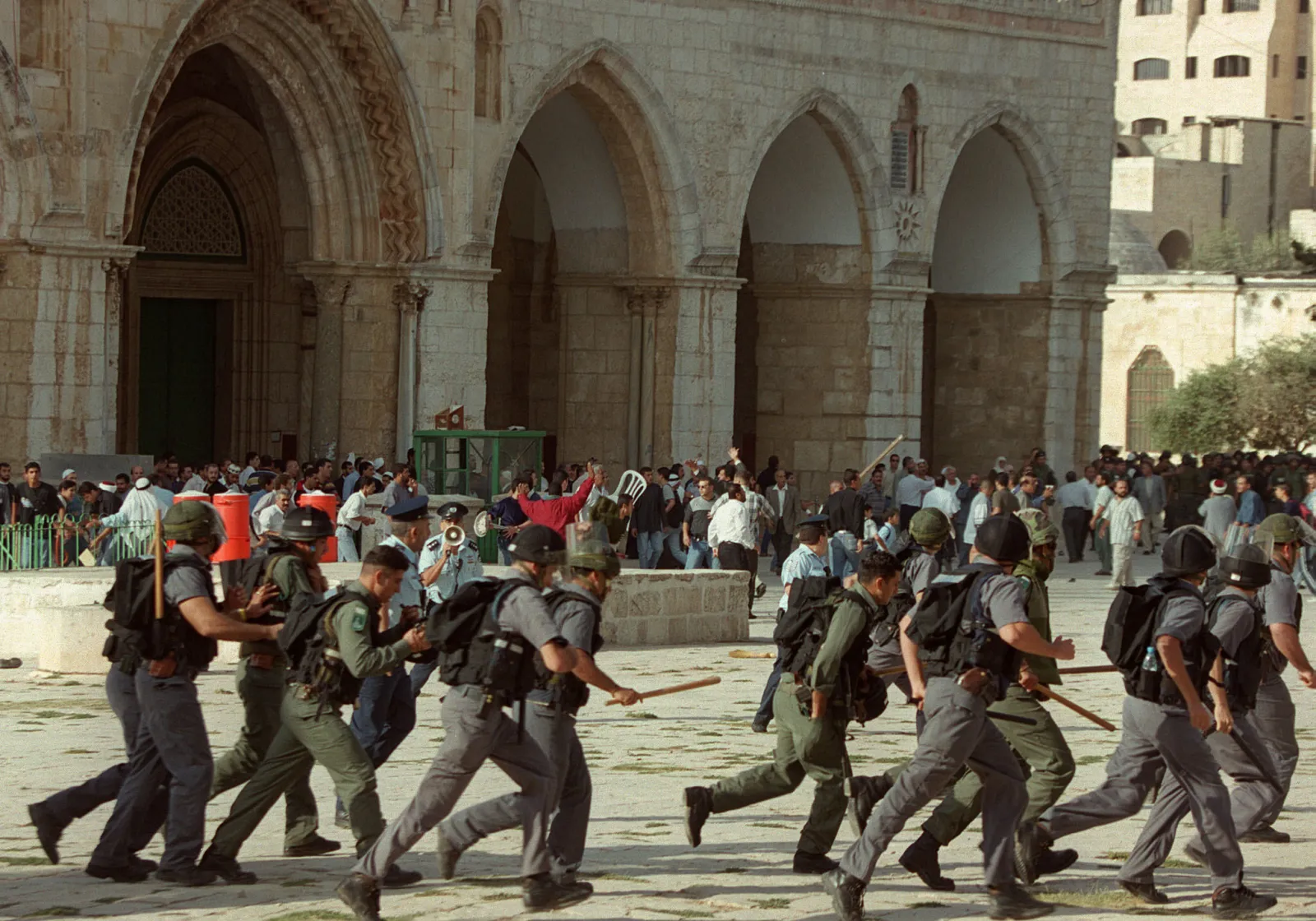
Those episodes do not prove that every change at the compound causes violence, but they show how new security measures introduced without consent, or provocative visits by powerful figures, can lead to catastrophe.
What’s more, the latest moves by Israeli police and the likes of Ben Gvir to reshape the arrangement in Jerusalem come at a time when the whole region is in turmoil.
Netanyahu this week poured cold water over the Board of Peace plans for an Israeli withdrawal from Gaza, saying Israel would not pull back from its current lines until Hamas was completely disarmed.
The U.S. and Iran are locked in a cycle of on-again, off-again conflict with global economic consequences.
The Gulf States, pulled into the fighting, are on high alert, and Yemen’s Houthis are threatening the Red Sea. All this as Israel gears up for a pivotal election in October that could decide the fate of Netanyahu and his hard-right backers in government.
These ingredients create an extremely volatile mixture, turning the tiny Temple Mount or Al-Aqsa compound into a spiritual Strait of Hormuz.
If it explodes, conflict in the Middle East will be reinforced with yet more complexity—the religious kind that makes compromise far harder and mobilization far easier.