WTI likely to pull back after recent rebound
WEST Texas Intermediate (WTI) crude prices have rebounded more than 20 per cent since the beginning of July, after retesting the pre-Iran war level of US$68 per barrel on Jul 2. The recent rebound in WTI crude prices could be attributed to several factors.
First, the market had initially removed the geopolitical risk premium following a de-escalation in the conflict, based on the memorandum of understanding (MOU) signed between the US and Iran.
However, disputes over commercial shipping in the Strait of Hormuz led to a breakdown in diplomacy and the collapse of the MOU on Jul 7.
Thereafter, renewed US airstrikes on Iranian infrastructure and Iranian retaliation against US bases in neighbouring Gulf states led traders to reprice the geopolitical risk premium into the oil market.
In addition to the Hormuz disruption caused by renewed military action, the threat to alternative shipping routes posed risks as well.
Yemen’s Houthi militants threatened to blockade Saudi Arabia’s maritime traffic in the Red Sea. Such a move would disrupt Saudi Arabia’s oil exports of between 3.8 million and 4.7 million barrels per day via Yanbu, its western Red Sea port, using a cross-country pipeline that bypasses Hormuz.
Last but not least, the depletion of the US strategic petroleum reserve (SPR) sent the risk premium surging back into the oil market. US SPR inventories fell by 5.1 million barrels in mid-July to reach the lowest level since 1983.
In the months following the outbreak of the Iran war, emergency stockpiles were heavily drawn down to artificially suppress prices. This included more than 44 million barrels from Organisation for Economic Co-operation and Development government reserves.
With strategic reserves nearing operational bottoms, the buffer to dump liquidity onto the market to cushion price spikes was removed.
From a technical perspective, WTI crude prices had reached oversold conditions by Jul 2, following a 40 per cent retreat from the peak of US$119 per barrel in early March.
Following the recent rebound, the price reached an area of resistance where it was likely to pull back.
On Jul 20, the price retested the 50-day simple moving average (SMA) resistance at US$85 per barrel, which had previously acted as a dynamic support from mid-April to mid-May prior to a breakdown.
This is also confluent with a retest of the horizontal support breakdown level on Jun 15. Looking at the Moving Average Convergence Divergence (MACD) technical indicator, the histogram has rebounded close to near the zero line, which is likely to act as a resistance after a breakdown below zero in mid-May.
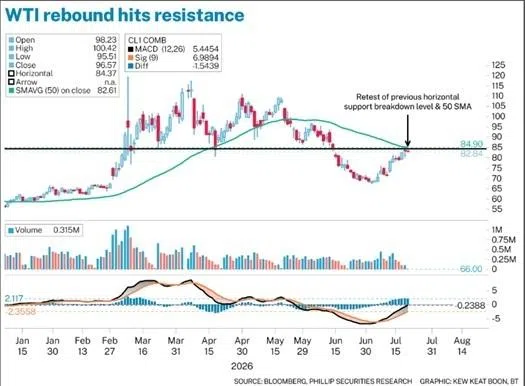
To conclude, WTI crude prices have staged a rebound since the beginning of July due to escalation in the Iran war, threats to alternative shipping routes, and the depletion of the US SPR.
However, the recent rebound to retest the US$85 per barrel level would likely hold as a near-term resistance for prices to pull back.
At the time of writing, efforts by mediators to recommend proposals to ease hostilities – such as a 10-day halt of strikes – would provide a catalyst for oil prices to ease should they lead to a detente.
The writer is a senior research analyst at Phillip Securities Research